I watched the movie "Chasing Ice" last night, and a few days ago, I also saw a 1960 movie by George Pal, "The Time Machine". The first similarity that struck me was the use of time lapse photography in both movies. In case you have never seen this classic movie, The Time Machine, maybe you want to skip this review that includes spoilers. Now go and see the movie, or maybe read the book.
The Time Machine is based on an H.G. Wells science fiction book from 1895, where someone invents a time machine and travels forward 800,000 years to the future to see how the world has progressed. The time lapse photography is used to simulate the effect of moving forward rapidly through time to the future.
Chasing Ice is a documentary by James Balog about our world's beautiful but disappearing ice landscapes. In this documentary, time lapse photography is used to speed up the shrinking of glaciers so that you can see in one minute, what took five years to occur naturally.
In a way, both movies are about the same thing. They are predicting the future, and have something to say about humans causing this future. The main difference is that "The Time Machine" has to go forward 800,000 years to see what will happen, while Chasing Ice only needs to go from 5 years ago to the present time, to see what will happen. Chasing Ice needs no time machine, nor does it need to invent a future. It is enough to show what has happened in the last five years, and from there, scientists have told us what will happen next.
In The Time Machine, no global warming seems to be happening. H. G. Wells is more worried about what will happen to mankind, if the gap between the rich and poor increases, and if we continue having wars with technologically advanced weapons. According to his vision, 800,000 years in the future, the rich classes (called the Eloi) will have lost their energy and will to succeed, while the working classes (called the Morlocks) have moved underground, and evolved into a different species that now uses the Eloi as feeding stock. H.G. Wells explains this in terms of evolution and predictable outcomes of social and economic forces. However he does seem to be discouraged that the Eloi have no will to resist the Morlocks, nor any desire to even rescue each other when danger looms. The Eloi seem like brainwashed zombies sleepwalking to their doom, not curious about what is happening or why. The Morlocks, while looking like beasts, at least have drive, cunning, and curiosity.
Now here is where another parallel appears. If you believe the rapid warming of the planet may have disastrous consequences, then we are already in some ways like the Eloi. Because humans taken as a whole, do not seem to have the will or even the curiosity to fight back. Mankind has the same attitude as the Eloi in that we simply accept what will happen. Another similarity is that our present situation is being controlled and manipulated by present day Morlocks. I don't mean that they look scary or anything, but there seems to be a split between rich and poor that is growing. I'm going to call the Morlocks the rich, who benefit materially from a passive working middle class. I don't mean to imply that the present day Morlocks are eating the present day Eloi. They are just using them to get richer and more powerful. And cynically manipulating them through controlled messages on TV, Internet, newspapers, and radio.
H.G. Wells' original Morlocks actually evolved from the poor and working classes, while the Eloi evolved from the rich idle classes. I'm not sure this is made abundantly clear in the movie, but I read the book after I saw the movie. The book is far more left wing in it's attitude than a movie (which was made during the cold war) could ever be, and Wells' opinions are made clearer in the book.
My interpretation of Chasing Ice in 2012 has the Morlocks and Eloi in role reversal, but I think the main point is that in both movies mankind is passively accepting a situation that is within their grasp to change. And in both movies there exists a class divide that pits an aggressive class against a passive class.
In the end, both movies are looking at how the world changes. But for H.G. Wells, the changes are so slow as to require 800,000 years and a time machine to see. For we humans of 2012, cataclysmic changes are so speeded up that a time machine is superfluous.
Tampilkan postingan dengan label climate change. Tampilkan semua postingan
Sabtu, 01 Desember 2012
Minggu, 18 November 2012
Electric Vehicles Perform Some Functions Better than Gas
Today the Globe and Mail had an interesting headline: Why modern electric vehicles are like cars from 1905
http://www.theglobeandmail.com/globe-drive/green-driving/news-and-notes/why-modern-electric-vehicles-are-like-cars-from-1905/article5374751/
I could not figure out what the headline meant, even after reading the article. Anyway, one comment got me motivated to write a blog, it goes like this
Edgenet 9:23 AM on November 17, 2012
"Electric cars will never replace the gas cars. Electric cars are for crazy professors and people like them that do not live in the real world."
I know many other people think the way Edgenet does. So it's time to have a public service lesson in how an average Canadian uses a car. I do not wish to argue that electric cars will completely replace gas cars. But they will be increasingly creating niche markets alongside gas cars, where a family may own one of each. So instead of owning three gas cars, a family may own two gas cars and some kind of an electric vehicle. Electric cars are not just for crazy professors and people who don't live in the "real" world.
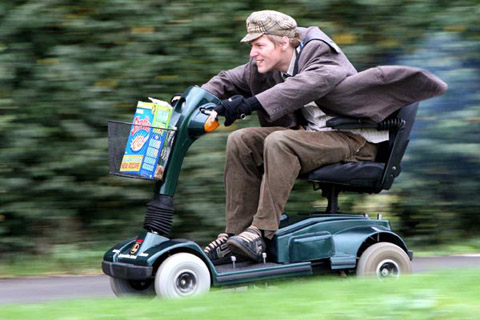
Although I don't have statistics in front of me, I know that many Canadians are turning to electric four wheel and two wheel vehicles to get around. The four wheel vehicles (also called mobility scooters) are often used to go to supermarkets for shopping, and can in fact go right inside the mall or supermarket, because of their electric technology, and because their owners have great difficulty walking. You may not want to call these things "cars", but they use the same technology, and they perform the function that a car used to perform, but do it better. Their batteries and charging systems are adequate today, to accomplish the goal of shopping.
A second use for an electric car, this time a more conventional electric car, is getting kids to school. School busses do not carry all the kids, for proof you only need to go by a school at 3:00 to see all the parents waiting for the kids to come out. Those people drive their kids to school or back four times a day, with a cold start each time. And it is getting to the point where some families have a minivan that is only used for this one purpose. Toyota is having some problems with engine failures in minivans whose oil turns to sludge and burns out the engine, because the vehicles never get operated for more than 15 minutes at a time. So the engine never has a chance to get up to operating temperature. Families who use a minivan like this, usually also have huge four wheel drive pickups and SUV's that they use for longer trips, relegating the minivan exclusively to school shuttle duties. It would make a lot more sense for this type of work to be done with an electric vehicle, that needs no oil changes, no gas fillups, no warmup time, and does not burn out the engine on stop and go driving. 200 mile range and top speed of 100 mph are not needed in this application. Just plug it in at home and drive around the block when you need to.
I don't necessarily agree with driving the kids to and from school four times a day, but I'm just observing the "real" world that I see developing around me.
Picture: Taken from this website "EV World The Future in Motion"
http://evworld.com/news.cfm?newsid=27678
Jumat, 17 Februari 2012
Do We Really Have to Pay the US to Take Our Electricty
For a few years now I have been listening to opponents of wind energy make claims that it is too expensive, too erratic, and we have no way of storing the excess energy for use at peak hours.
I have been sceptical of these claims, but one story I read recently tops them all.
On CTV news, "energy expert Tom Adams, told CTV's Queen's Park bureau chief Paul Bliss. "We have to get rid of it. It's a disposal problem and sometimes our neighbours need to get paid in order to take custody.""
He was of course referring to wind energy, and the claim that Ontario must pay neighboring states to accept energy from our grid when we have too much.
I don't really know if this is blatant propaganda or not, because I can imagine a situation where we would have to pay to get rid of something that might be harmful to us. In electricity, this is not uncommon actually. For example, there are times that you need to shut down a high voltage power line, and you need very expensive equipment to do it, because a sudden shut-off builds up the voltage. If you do not have this equipment, you may need to pay someone to do it for you - in theory anyway. Another example of excess energy is a car travelling at high speed that needs to stop suddenly. That kinetic energy has to go somewhere, so hopefully you have brakes to disperse it. Some cars have brakes that store the energy (like the Prius). Other cars have no brakes (like my '72 Corolla after it lost a wheel strut), and you have to find some other way to get rid of your energy. If you plow into another car, that other car takes your energy, but in the end you will have to pay - either direct costs or in insurance premiums.
So are we talking about some kind of shock absorbing system being provided by our neighbours, because Ontario does not possess any way to recapture excess power? Or is there actually any known way to either recapture excess power, or to at least burn it off? Wind energy opponents have told us it is not possible to store energy, which I believe is not only false and misleading, but goes against all common sense. But now apparently they are saying there is no way to even dump energy, without paying the US to do it for us.
Upon researching this story further, I expected to discover that there was some unusual, hopefully temporary, situation that forced Ontario to dump excess energy into the US grid. For example, an unforeseen spike of wind energy combined with an unforeseen reduction of power requirements. In a brief span of time, it might have been impossible to shut off the wind turbines or the water power, nuclear power, gas fired, or coal power plants. So maybe we had to pay money until some parts of the energy generating system plants could be shut down. I don't know how long this might take, as I am not an "expert". But it seems to me that a month is a bit excessive simply to reduce our power output just a little.
So in my opinion, this story is planted to mess with our minds, and to soften us up so that we stop questioning the anti-wind power "experts" on their outrageous statements.
I do not believe that it takes a month to reduce our power output to the point where we stop paying a penalty to the US.
I do not believe there is no way to burn off excess energy harmlessly.
I do not believe that there is no way to store energy, although its possible that Ontario needs to build some, or more than they already have.
If you want me to believe those things, a lot more explanation will be required than the statement of another energy expert.
Tom Adam's blog
http://tomadamsenergy.com/
Tom Adams refers to this article "perhaps the most coherent, balanced and accurate explanation of wind power to so far appear in the Canadian print media." in his blog post titled "Excellent Journalism re. Wind in Ontario’s Power System"
http://www.montrealgazette.com/technology/wind+power+more+complicated+than+people+imagine/3376723/story.html
Quote from this article (which refers to Tom Adams as a source.)
"For a full month the price of our power was negative — that is, we were paying utilities in Ohio and Michigan to take it off our hands.
Private energy analyst Tom Adams thinks that could happen again when we lean more heavily on wind power. Wind turbines can shut down in high wind, but Ontario would still have to pay them for the power they aren’t generating, like a diner who orders a restaurant meal and doesn’t eat it. It’s called “curtailed output.”"
Kamis, 27 Oktober 2011
Time to Reopen the Climategate Debate
Most Americans now believe that global warming is a hoax. Not only that, but many also believe that science itself is unreliable, and believe that most scientists in any field of research will fudge figures in order to obtain research grants. Most of this ill-will came about because of the controversy around global warming, and specifically the stolen emails from climate researchers that seemed to indicate they were using underhanded methods to "fake" global warming. (A.K.A.Climategate).
Making things worse, science itself seems to still be locked in mortal combat with the religious fundamentalists about the theory of evolution, and the fundamentalists are lending their financial resources and publicity to the fight against real science. (I use the term real science because the fundamentalists' latest tactic is to claim to be an alternate, "honest" type of science where the Earth is only 6,000 years old)
It is really sad to see popular opinion turn against science. I can understand my sister, who is a fundamentalist Christian, thinking that science is evil. I have a harder time accepting that a friend I made in Africa with CUSO believes the same thing. Even harder to believe that old college friends, from the science program at university, also believe that global warming is a hoax. These are just the people I know personally who believe the Climategate scandal. I assume the public opinion polls are right, and that many more people believe the same way.
But apparently last week there was a bit of a breakthrough. An independent voice took another look at global warming data, to see if the Climategate scandal was true. A report came out by Richard Muller, who is a scientist who in the past was skeptical about global warming. Richard Muller obtained funding (some from oil companies, apparently), assembled a team, and embarked on a project to find out if the data from Climategate did indeed indicate warming or not.
http://www.smh.com.au/opinion/politics/chilling-news-for-climate-sceptics-20111027-1mm5d.html
The above article indicates that his independent effort corroborates exactly what global warming scientists have been saying.
Does this mean the end of the controversy? Of course not. This report has been given almost zero air time, compared to the massive publicity that was given to the stolen emails. In fact it was given almost no air time even compared to the coverage of MacDonald's new McRib, according to Jon Stewart of the Daily Show (Oct 26, 2011). Also, Forbes Magazine ran an opinion piece by James Taylor "The Birth of a Straw Man" that basically said Richard Muller had not done any new research and that Global Warming was still a hoax.
http://www.forbes.com/sites/jamestaylor/2011/10/26/the-death-of-global-warming-skepticism-or-the-birth-of-straw-men/
The Forbes article, if you choose to read it, claims Richard Muller's research is a failure, because it does not turn up anything new, and because it does not answer the question of whether or not global warming is man-made. Well, of course not. It was intended to only look at climate data from weather stations - because that was issue of the Climategate controversy. It was a very comprehensive study to see if the data had indeed been fudged to get grants, as was claimed by the press. And it found the climate scientists not guilty. Too bad people like James Taylor are given so much space in influential magazines to air opinions that a fifth grader should be able to rebut.
Of course, Richard Muller's study is only a small part of the huge amount of research being done on Global Warming. True, it brings no new information to light, but it is an independent fact checking on the scientists who were accused of fudging their figures to obtain grants. They didn't. Now can we resume an intelligent conversation about Global Warming, or is it too late?
OK then, while we wait, how good is that new McRib burger?
Selasa, 18 Oktober 2011
Glenn Fox, Trashing Green Energy Again
It seems Glenn Fox is up to his tricks again. He has co-authored a report claiming that green energy is too expensive for Ontario. I saw this report mentioned on TV today.
I have written two other blogs in relation to Glenn Fox. One about a different University of Guelph's economics professor and his political one sidedness when it comes to Green Energy.
http://slickerrain.blogspot.com/2011/03/university-of-guelph-economics.html
The next was about a lecture I attended by Glenn Fox titled "It's not easy being green"
http://slickerrain.blogspot.com/2011/02/glenn-fox-phd-lectures-seniors-on.html
This previous blog attracted a few comments that were debated at length. And unlike the usual web comments section (for example the CTV article linked at the top of this blog), the debate on my blog was civil, and ranged from scientific to philosophical.
At the end of the debate I admitted that while I could give my opinion that lecture I attended was one-sided, I probably should not judge the rest of Glen Fox's life work as being equally biased against environmentalism and alternate energy.
Now Energy Minister Duguid of Ontario Government is saying that this new report is one-sided and flawed, and that one of the authors is known to be anti-alternate energy. I wonder if that biased person could be Glen Fox?
Senin, 10 Oktober 2011
Port Dover Chronicles 10/10/11

For all you people who think a warm day proves the Global Warming theory, or all those who think a cold day proves it is a gigantic hoax, I would like to explain why you are wrong.
Today I went down to Port Dover on my motorcycle and it was about 25c. This is at least 10 degrees C over the normal average high for this time of year (Oct 10). It is the Canadian thanksgiving weekend, and I cannot recall seeing people sunbathing and swimming on this weekend before.
But even this strangely warm day does not prove global warming, because it is still within the normal range of temperatures. In the winter we can have highs of -20c, and in the summer highs can be up to of +38c.
Global warming theory predicts a change in average temperature a hundred years from now of only about 2 degrees Celsius, which is so small that you could not "feel it" even if it were 100 years in the future and global warming (for the sake of argument) had come true.
And while I'm in the mood for an educational blog message - Canada's Thanksgiving comes a month earlier than the USA because we have an earlier harvest, not because we need a head start on our prayers to God. And Al Gore did not "invent" global warming, other scientists had proposed it long ago. There is a Youtube video with scientists from NOAA warning of global warming in 1984. The video could be mistaken for something produced this week, because it is still close to current scientific findings.
http://www.youtube.com/watch?v=jSLS2A1nxHs
Picture 1: Me leaving home this afternoon, wearing my warm weather motorcycle gear. Only a t-shirt under the unlined leather jacket. Signs of the times include the tree turning yellow, the car with its winter tires already on, and the election sign still up on our front lawn.
Picture 2:
These are the palm trees at Port Dover that need to be replanted every spring. I sometimes screw up pictures not realizing there is some background thing like a telephone pole ruining the picture. This time there was a dead branch in the foreground hanging down. But I decided to keep it in there because it looks like the tentacle of some space monster coming to get the girl who is sunbathing on the beach. There is an appropriate quote I hear all the time: "When life gives you lemons, you make lemonade". Assuming life also gives you sugar and water. And if life also gives you alcohol, make "Mike's Hard Lemonade", which I am drinking right now after that long hot ride.
Jumat, 08 April 2011
"None So Blind as Will Not See" Does Not Apply to Everyone Equally
There is an old adage "There are none so blind as will not see". Recently this quote was used in a response to one of my blogs, citing Jonathan Swift as the source. The saying refers to a person who refuses to see the truth, who is "blinded" by something. The "blinding" could be as a result of many things, for example: education, parental values, patriotism, habit, stubbornness, fear, or hate.Another commenter responded that even if this adage applies to a given controversy, it is impossible to know which side is the one that "will not see". I wanted to investigate whether there is indeed a pure symmetry in the statement of who "will not see", or if there are some characteristics that would lean the "will not see" to one side or the other.
Swift's quote was used as cliche in polite society. The idea appeared in the Bible, too, where you were told to remove the plank from your own eye before you tried to remove a splinter from another person's eye.
When I looked up the quote by Jonathan Swift, I found it in "Polite Conversation". Jonathan Swift in his typical ironic style, explains in the introduction that he is writing a book that captures all the witty repartee (and apparently cliches too) of "Polite Society".
http://www.ebooksread.com/authors-eng/jonathan-swift/polite-conversation--in-three-dialogues-hci/page-8-polite-conversation--in-three-dialogues-hci.shtml
Dialogue III 174
.....
Lady Answ. They say, she's quite a
Stranger to all his Gallantries.
Lady Smart. Not at all ; but, you
know, there's none so blind as they that
won't see.
Miss. O Madam, I am told, she
watches him, as a Cat would watch a
Mouse.
.....
An upper class lady "would not see" that her husband was fooling around, even though everybody else knew about it. I guess we could generalize that as anyone in a very comfortable lifestyle, who will tend to ignore warning signs of serious problems they don't know how to deal with.
How can we apply this quote to the global warming debate? We are fond of our lavish lifestyles, with cars, SUV's, big houses, plentiful cheap energy all around. We would prefer to not think about what damage our lavish lifestyle is doing to the environment. We would prefer to not think that our need for resources causes wars even as it creates pollution and waste. So we turn a blind eye to the bad side, and continue consuming more and more, ignoring anyone who tries to warn us, or tell us anything that might burst our bubble.
So if we look at the environmental controversy, it is not actually symmetrical. Both sides would prefer in their hearts to believe the same thing, that pollution, global warming, overpopulation etc. will never cause a problem. The one "uncomfortable" side of the controversy is to believe that something is going on that we must take difficult steps to prevent.
So in this controversy, I believe we can all agree that one side of the argument is the preferred side, the other side is the uncomfortable side. One side is the one we desperately want to believe, the other side, if we believe it, can make us unhappy, and may force us to do something about it.
Global warming deniers fall into two camps. One is to believe that there is no global warming, that this is all cooked up figures by rogue scientists to try and get grants, or to impose a socialist government. The other view is that yes, the earth is warming, but this is a natural process, and there is nothing we can do about it anyway.
With the two denial camps I have referred to, "There is no warming" vs. "Warming is natural", it is amazing to me that most people I know believe both arguments simultaneously, which strikes me as illogical. But I guess they're really saying "Hey nobody really knows anything for sure, so I can believe both at the same time"
Although there are warning signs, deniers would prefer to either ignore them, or blame everything bad on socialists or environmentalists, or just Al Gore. We would ignore warnings rather than than scale back our God given lifestyle to any degree. We would rather deplete our oil supply than begin developing renewable technologies that may prolong our civilization. Instead of exercising caution, we write articles about how caution is overrated.
Like the upper class lady with a cheating husband, even when we really do see disasters happening, we often "do not see them" and carry on as usual. Two recent examples, the 2008 economic crisis and the BP oil spill, the multi million dollar bonuses paid to bank executives who nearly wrecked the world's economy, and more recently multi million dollar bonuses paid to oil executives involved in the spill. Apparently there is no disaster big enough to force comfortable people into a reality check.
I believe that the expression "None so blind as will not see" is appropriate for global warming deniers. It does not prove that global warming exists of course, merely that the deniers are the ones who really should ask themselves if they are on the side of truth, or if they have succumbed to the common human failing of refusing to see anything which is a threat to their comfortable lifestyle.
Picture: Blind driver off the Internet. Motorcyclists always say the car drivers are blind and are out to get you.
Sabtu, 02 April 2011
Viral Video Gone Wrong: Eugenie Harvey
By The Lost Motorcyclist, April, 2011I am trying to make sense of an awful video advertisement produced by an environmental group called 10:10, which was trying to get people to reduce their carbon footprint through video public service announcements (or ads). So here I have written my own opinion on the post mortem of that train wreck.
One of the trends in advertising today is viral videos. Instead of running your ads on TV, at huge cost, you can leverage them by putting them on Youtube, and hope they become "viral", meaning millions of people forward links to their friends. Ultimately, popular viral videos even make it onto the regular TV news programs. This gives them high impact and advertising for little cost. Unfortunately, in order to go "Viral", your ad must have a big enough impact on a viewer to make them want to tell their friends about it. So your ad needs to be extra edgy, with content shocking beyond what you can see on network TV. And there may even be slight temptation to not seek everyone's approval of the ad before posting it, for fear of losing that edge. But there is a possibility of a backfire, which can destroy your campaign, with no hope of ever pulling the viral video back out of circulation. Because a viral video, if it takes off, can be like an uncontrolled nuclear reaction.
This is a story of a young, inexperienced, environmental PR group, directed by Eugenie Harvey, trying to run an ad campaign with a shocking video advertisement. They obviously were looking for a certain Monty Pythonesque humour, and they did achieve that, but it was completely at odds with the goals of the campaign.
Ten-ten realized very quickly that the ad was a mistake. They lost some important sponsors over the release. Because they were an environmental group, they also damaged the credibility of other the people working for the environment. In the end, Fox News caught up to the ad and broadcast it to America. The propaganda value from something like this is so valuable to the anti-environmentalists, that Fox News risked going over the bounds of good taste to make sure everyone saw it. And of course, Fox would need to mention that everyone in the environmental movement is really like this underneath their fake exterior disguise. (in case you didn't know, Fox News is anti-environmentalist)
The Fox news bit starts with the typical call to "Outrage!" and shows the clip, with appropriate conservative anti-global warming commentary.
http://www.youtube.com/watch?v=jqTd0g48ZY4 (there is a graphic violence warning)
Full original ad here. (contrary to Fox's statement, they probably did show the worst of it.)
http://artthreat.net/2010/10/1010-campaign-heads-explode/#
Here is an article about 10-10, the group that launched the ad. It is a British environmental group I never heard of before this Fox News video, which appeared on October 10 last year.
http://www.guardian.co.uk/environment/2009/dec/31/eugenie-harvey-10-10
This "humour" may pass as funny to the younger generation in Britain, I suppose. But, humour does not travel well. I have had discussions with some of my kids (even while adults) about "too much violence on TV" and they think I'm an old fuddy duddy.
Given the huge negative impact of ads like this, I am a little bit tempted to think it was a set-up by a covert anti-global warming operative. But the only suspicious background I could dig up was that Eugenie Harvey, the director of 10:10, had earlier worked for FoxTel (Owned by Rupert Murdoch, owner of Fox News Channel).
My own final verdict is it was probably a genuine attempt at making a pro-environment video go viral, but that backfired big time.
Picture: Randi Zuckerberg (of Facebook) and Eugenie Harvey (of 10:10), ironically discussing ways of leveraging small non-profit advertising impact back in June 2009. On this blog:
http://www.chroniclebooks.com/blog/2009/06/22/all-for-good-arianna-huffington-randi-zuckerberg-and-eugenie-harvey/
Kamis, 25 November 2010
Can We Learn Something from Caribou about Environmentalism?
There may be a debate about whether we should use wind power, about whether global warming exists, or if oil is indeed running out. But in that debate, I feel there is no doubt that one side is treating nature with respect, while the other has a superior attitude. As if Man can defeat nature with his immense brain and technology.There are some lessons to be learned from native people about our relationship to the environment. Here is a story I found in Goliath
http://goliath.ecnext.com/coms2/gi_0199-5961784/Knowledge-learning-and-the-evolution.html
"According to narratives by Chisasibi Cree elders in the 1980s, a disaster occurred in 1910 at Limestone Falls, near the center of the Quebec-Ungava peninsula (Berkes, 1999, chapter 6). Equipped with repeating rifles that had just become available, hunters abandoned their hunting restraints and conventional ethics of respect for the animals, and slaughtered large numbers of caribou at the river crossing point. The caribou had already been in decline along the Hudson Bay coast. Following the event at Limestone Falls, the herd disappeared altogether from the lands hunted by the Cree and did not reappear until the 1980s. The Cree believe that all changes occur in cycles, and the elders at that time had predicted that the caribou would return one day."
You could argue that it was not one bloody and wasteful slaughter of the animals in 1910 that caused the caribou to disappear for over 70 years. After all, the caribou were already starting to dwindle. But there is no doubt that there was a lack of respect for nature in that 1910 hunt with the newfangled repeating rifles. Secondly, the lack of respect that year was a break from the traditional ways of hunting. The subsequent disappearance of the caribou certainly gave people a pause for thought. Over the next seventy years, the story was retold about the arrogance of the hunters in 1910, so when the caribou reappeared in the nineteen eighties, it didn't take too much to convince people to be respectful, and not wastefully kill the animals.
Are we to take this story as an example that being respectful toward nature is good? Or is it an obvious ploy to con the superstitious natives?
There are many such stories told all over the world, of native groups who have either managed their resources carefully, or wasted them. Some have survived, and some have disappeared. Funny thing is, it is not always the natives who manage their resources well who survive, and being wasteful does not guarantee the humans will not survive.
My own feeling is that it is better to show respect for nature than to wantonly destroy it. You may call that a spiritual feeling, because I sure can't prove it is scientific. You could also call it Karma. Something rings true about people who are most boastful, and wasteful, and full of themselves falling hardest.
If we go back to the same time, about 1910, it was believed that the cod on the Grand Banks were so plentiful they would never run out. And we ran our fishing industry on that belief, until the cod actually ran out. Luckily, with our global system of commerce, we can continue to snack on fish that comes from China as easily as the stuff that used to come from the Grand Banks. And as species get depleted, instead of protecting them, we continue to eat them at a great rate. Bluefin Tuna is endangered? Great, I think I'll order some for my dinner. That attitude shows a lack of respect for nature.
I'm sure people have some natural instinct to be respectful of nature, but somehow it is being lost in our modern global economy. Maybe it is propaganda that has got us convinced to consume, waste, throw stuff away without a guilty conscience. Maybe if we had a chance to think for ourselves, we would be cautious, and take only what we need. It may also make us happier people. We are certainly not that happy in our consumer-oriented throwaway society.
But ultimately, we may need about a 70 year catastrophe to convince us to be frugal with out resources. And then, we can just pray for a second chance. Imagine that we ran out of oil for seventy years. Seventy years of hearing stories from our elders about the old days, when people drove Hummers "just for the hell of wasting oil". Then one day, someone finds a new, huge reserve of oil. Do you think it would take much to convince those people to take the bus or a train instead of a Hummer?
Label:
canada,
climate change,
consumerism,
environment,
history
Senin, 19 April 2010
Two More Pet Peeves with the Media
Some of my most frequent pet peeves are people in the media "explaining" an issue in a completely ass-backwards way. So part of the fun of writing a blog is to put out my own take on an issue that has been poorly explained to the public by the TV and newspaper media. Two such stories come to mind today.First is Canada's new rules for mortgages, tightening up the requirements for obtaining and keeping a mortgage. I didn't keep track of which news person said this, but I'll bet she was not alone. She was talking to an expert, and asked "This probably means that the average home buyer will have to be paying more for their house. How much more will we have to pay?". If you spotted the error already, good for you! The error is this: By tightening up the credit rules, home buyers will pay LESS for their homes, not more. You heard that right. Most people buy homes on credit, that's what a mortgage is all about. They usually buy the most expensive house that they can afford. The person who tells them what they can afford is the banker who approves the mortgage, and the bankers do the calculation according to set rules, based on the buyer's financial position. When you tighten up the rules, you are effectively saying "You cannot afford this $500,000 house, therefore we reject your mortgage request. However, we would be able to approve of a mortgage for $350,000". The numbers here are just an example, but it gives you the idea that people will be spending less. Even for people who buy a smaller house than their limit, they will pay less because they will not be extended as much credit, therefore less interest to pay.
My second complaint was stirred up by a comment by one or more meteorologists, that they are better able to predict global warming than climatologists. (March 29, 2010 New York Times). I know this story is almost a month old, but I'm actually focusing on a problem with the entire meteorological business, that has been going on for a while. The weathermen and women on TV keep pounding us with the message that "warm is good" and "sunshine is good". It sounds something like this "We have some good news for the weekend, sunny and warm with no chance of rain." Listen to the weather forecasts yourself, and in about 99% of them, the meteorologist attaches the words "good news" to any report of sunny and warm, and some variation of "bad news" to any rain, snow or cold.
The one exception is when a forest fire is destroying million dollar homes in California. Then they switch around the good to bad.
This attitude is not scientific, which confirms my opinion that most of these weather girls and men are more announcers than scientists. But for heaven's sake, do not make your pretty faces even redder by claiming to have greater scientific knowledge of climate change than climatologists. Meteorologists have a hard time predicting 5 days ahead, and have been totally brainwashed into thinking warmer is better. These are not the people to be deciding if it is good or bad that the climate gets 5 degrees warmer in the next hundred years.
Picture: It looks like a Spanish language station, so just to be clear, I didn't choose the picture because their forecasts are worse, but because their forecasters are better looking.
Sabtu, 27 Maret 2010
Little Ice in the Gulf of St Lawrence for the Seals
A story about the annual seal hunt was briefly mentioned on Radio Canada news on TV (in French). Just to recap: 30% of the annual eastern seal hunt in Canada is in the Gulf of St Lawrence, a large sea area bounded by Quebec, Newfoundland, Nova Scotia and New Brunswick. Usually the seals have their pups on pack ice which is always plentiful in the gulf at this time of year.But in 2010, the Gulf of St Lawrence for the first time has little or no ice for the birth season and the seals are either having their pups in the water, or some are having them on the beaches or rocks. In either case, the survival rate is quite low, although it may take some time to figure out the true effect of the lack of ice on the seals. http://www.harpseals.org/resources/news_and_press/2010/seal_hunt_10.html
This comes at a bad time once again for the hunters. Although they have seen prices drop from $100 to $16 per seal pup since Europe banned the import of seal fur, medical research has indicated that baby seal heart valves may be superior to any existing heart valves used for transplants to humans. If this proves to be true, the seal hunt would be set to stage a comeback.
I would like to see this whole seal/ice story get more coverage for two reasons. First, to show that the seal hunt is really not that cruel, if you compare it to the hardship and suffering in nature, rather than the coddled life of human pets. And second to offset the anti-global warming stories that multiplied as the Eastern USA had a bad winter. Environmentalists could have a propaganda windfall with this, if they used it like they did the stories of polar bears drowning.
Also, for people who happen to think that an ice-free Gulf of St Lawrence is a good thing, the Magdalen Islands are suffering a major amount of erosion this year, and it's going be expensive to save some of their exposed real estate. Pack ice along the shore usually acts as a barrier to the waves from spring storms.
Rabu, 03 Maret 2010
The Propaganda of Climate Change

Last week I came across an article about the Anti-Global Warming campaign on a website called Common Dreams. Originally it was posted on Tomdispatch.com on February 25, 2010, by Bill McKibben.
The reason I write this today, is because the Kitchener Record just printed the article. So thumbs up to the Kitchener Record!
And the original story
I was especially interested in the article because it is about the propaganda aspect of the debate, not the scientific aspect. I'm actually pretty much burned out on the science of Climate Change. Even though I studied science at University, I am nowhere near qualified to calculated the rise in global temperature from fossil fuels. I imagine the formula is something like this: iT = (Bob + CB + NGB + MCF)*x*Fe - Pwcu * Lopd
Where
iT = Increase in Temperature of Earth due to human related activity
Bob = Barrels of oil burned
CB = coal burned
NGB = natural gas burned
MCF = Methane from Cow Farts
x = constant to be figured out when it's too late by computer modeling
Fe = feedback effect
Pwcu = people who can't understand
Lopd = Loudness of pseudoscientific deniers.
I admit it, I do not have the scientific training to work through it and come up with the answer. So I have stopped taking the bait of arguments like "You are aware, aren't you, that Carbon Dioxide is only 4% of the total greenhouse gas effect?"
I don't mean to make a personal attack here, this applies to everyone. If anyone knows something about calculating the temperature of the Earth, they should take their case to a peer reviewed scientific process. Do not bring the argument to me. True, the scientific community may laugh at you and ignore you because you do not have a PhD. But I don't have too much sympathy for that. You get a PhD by working hard in university, and I happen to know many people do not work that hard and end up destroying their brain cells on beer and end up like George W. Bush.
Although I admit that I no longer have the brain cells required to calculate iT in the above formula, I can handle the math in the next formula, which is the Pottery Barn version of global warming. Simply stated, the premise is "We only have one planet to fool around with, and if we break it we all still have to live on it." The scientific formula goes something like this
NPE = 1 - Afabd
Where
NPE = Number of planet Earths that can support life
1 = Number of planet Earths in the known universe
Afabg = Any fooling around by deniers that results in destruction of biosphere whether inadvertent or intentional
That formula I can still work out for myself.
Picture: This is a picture where NPE = 1. I was not able to locate a picture where NPE was zero.
Rabu, 24 Februari 2010
Why has the Global Warming Debate Turned Political?
Why has Global Warming become a political issue more than a scientific issue?Before going in to this, I want to say that recently, political parties on both sides have admitted that global warming is a man made problem. In the last US election, Democrats and Republicans both pledged to do something about Global Warming. However, the rank-and file conservatives, and the conservative political commentators on TV and in the press, have generally continued to call global warming a hoax.
With very few exceptions, global warming deniers are conservative. Those few liberals who deny global warming would need to be looked at on a case by case basis, but I suspect that most of them would turn out to be false liberals, or somewhat confused about what liberals stand for.
So why do conservatives call global warming a hoax?
Conservatives in the USA tend to be more religious than liberals, and are guided more by the bible than by scientists, especially when those scientists deny God's creations and deny the literal truth of every word of the bible. Conservatives sometimes refer to Global Warming as an alternate form of religion.
In the USA, conservative has come to mean "opposed to governmental control and opposed to taxes", especially since the rich are taxed more heavily than the poor. One of the most obvious solutions to global warming would be to use government regulations, oversight and taxation. So Conservatives would prefer that global warming be a hoax.
From an article by Richard S. Lindzen 1992, who is one of the most respected global warming skeptics, (and coincidentally a "smoking causes lung cancer" skeptic and heavy smoker)
http://www.cato.org/pubs/regulation/regv15n2/reg15n2g.html
"As Aaron Wildavsky, professor of political science at Berkeley, has quipped, "global warming'' is the mother of all environmental scares. Wildavsky's view is worth quoting. "Warming (and warming alone), through its primary antidote of withdrawing carbon from production and consumption, is capable of realizing the environmentalist's dream of an egalitarian society based on rejection of economic growth in favor of a smaller population's eating lower on the food chain, consuming a lot less, and sharing a much lower level of resources much more equally.'' In many ways Wildavsky's observation does not go far enough. The point is that carbon dioxide is vitally central to industry, transportation, modern life, and life in general. It has been joked that carbon dioxide controls would permit us to inhale as much as we wish; only exhaling would be controlled. The remarkable centrality of carbon dioxide means that dealing with the threat of warming fits in with a great variety of preexisting agendas--some legitimate, some less so: energy efficiency, reduced dependence on Middle Eastern oil, dissatisfaction with industrial society (neopastoralism), international competition, governmental desires for enhanced revenues (carbon taxes), and bureaucratic desires for enhanced power."
Conservatives have realized that any money put into global warming may be withdrawn from military budgets.American conservatives have a negative view of the UN and of international cooperation. International cooperation is almost a necessity in combating global warming. And some transfer of wealth to developing nations may be required, which is generally opposed by conservatives.
Conservatives understand that to combat global warming, we must conserve energy, meaning reducing wasteful consumption and wretched excess. This would obviously impact rich conservatives far more than middle class liberals.
Conservatives, almost by definition, do not like to change, like to keep things the way they are. If we are going to do something about global warming, big changes are needed. Conservatives will generally oppose big changes.
Here are some examples of liberal opinions and goals that may make them more likely to do something about global warming than conservatives.
- Taxing the rich and profitable corporations is necessary
- Scientists can tell us more about climate change than the bible or religious prophesies
- We should live more frugally, conserve more, reduce waste
- The gap between rich and poor, between rich countries and poor countries should be decreased
- Reduced military spending, other than what is strictly needed for home defence
- Making the world a better place
- Reduced dependence on foreign oil (hence foreign military invasions)
- More government oversight of corporations
- Saving the environment
Pictures: I photoshopped two pictures to illustrate the impact of global warming at the North Pole. Can you tell if it is winter or summer? (Hint, the sun is up) And what time of day it is? All time zones converge at this point, so take your pick.
Sabtu, 13 Februari 2010
A Lesson from The Flat Earth Wager of 1870
Once again I want to call into question whether debating should be used as a technique to settle arguments about the validity science. For example, Creation vs Evolution, or whether global warming is real or a scientific hoax.I have been reading the book "Flat Earth, the history of an infamous idea" by Christine Garwood. There is a historical precedent that we might be able to learn from that we can generalize to all science vs. non-science arguments.
This historical debate was about the flat earth in 1870. It involved AR Wallace, who was coincidentally the co-discoverer of evolution.
A. R. Wallace took up a monetary wager against flat Earth promoter John Hampden. To win the wager, Wallace had to prove, to the satisfaction of a third party referee, that the Bedford Canal had a curve to its surface.
Wallace set two markers at a height of 13 feet above the water, one was at 5 km., the other at 10 km. He then used a professional surveyor's telescope with cross hairs, also at thirteen feet height and observed that the furthest marker was lower than the middle marker, by about 4 feet. The previously agreed impartial observer, William Carpenter, was then allowed to look through the telescope, at which point he joyously declared the points lined up therefore the canal was flat. No amount of persuasion could convince the observer that the middle marker was higher than the furthest marker.
Finally after days of wrangling, another judge, Walsh, was chosen, and he said that the difference in height of the markers clearly indicated curvature of the canal water surface. Furthermore, Walsh discovered that William Carpenter, the previous referee, was a close associate of John Hampden, and Walsh issued a statement in which he included the comment "The deception was, to say the least of it, 'unscientific'." (speaking of the choosing of William Carpenter who did not disclose his close collaboration with Hampton)
As a result of this comment by Walsh, John Hampden claimed that he was being libelled, and also accused the new referee of colluding with Wallace. Hampden took legal action to prevent the wager money being given to Wallace. After years of fighting in court, A.R. Wallace won the money, but ended up no further ahead after lawyers fees, and had done nothing to stop the spread of the "Flat Earth" philosophy.
What we can learn from this, is that scientists and anti-scientists do not have the same standards of fairness. Why would I say that, and how could I ever confirm it? Of course it can never be confirmed that anti-scientists are all cheats, and it does not even seem to be a reasonable statement. I would go further, and say it makes me sound like a lunatic that I would even propose that all anti-scientific people are liars and cheats. Therein lies the paradox that prevents a debate from being a good way to settle the matter.
For any debate to succeed, you need to have both sides willing to listen to reason, to abide by observed facts. But that very idea is at the heart of "The scientific method". If you can show me two people willing to listen to reason, and abide by observed facts, I will show you two scientists.
But the world at large, observing this debate, sees only two equally earnest sides, pro science vs. science deniers. If the pro science side ever at any time in exasperation, insults the science deniers for their lack of logic, for their hardball tactics, for their deceit, a whole new argument is launched. This new argument is about personal honour. In the new argument, the scientists were the first to insult the other. And they lose.
Selasa, 09 Februari 2010
Is This an Audubon Society Payoff Scandal?
If this were true it would be a little like CUSO taking a payoff to endorse the Liberian dictator Charles Taylor's policy of chopping off of hands of civilians in Sierra Leone. Or endorsing the bombing of native villages in the Sudan to clear the way for oil drilling. The Audubon payoff was not debunked on Snopes (as far as I could tell) so I had to investigate on my own.
"The Massachusetts Audubon Society ("MA Audubon") has been opposing the project from the beginning. They estimated that the turbines may kill up to 6,600 birds per year.
The controversy arose when MA Audubon changed their minds. They announced they would support the project on the condition that millions of dollars be spent to mitigate the ecological impact. As mitigation includes the monitoring of bird mortality and bird behaviour by ornithologists, this immediately led to suspicions of a conflict of interest."
First, to clear up a position. The Audubon Society has determined that while wind farms may kill some wildlife, they are a net benefit, based on our need to produce electricity in a way that does not promote global warming. And the Audubon Society also believes that global warming is a real threat, not a gigantic hoax cooked up by tree huggers. Which happens to match my own views, and those of my local Field Naturalists Club.
The timing of this "change of mind" and Payoff is not clear. But as of July 2005 (after the Feb. 2005 estimate of 6,600), the Massachusetts Audubon Society supported wind power. (I have the link below) As far as I know, all field naturalists clubs support the use of wind power.
http://www.massaudubon.org/news/index.php?id=200&type=editorial
In my opinion it is actually Exxon and the other oil companies that are fighting wind power with a well funded PR campaign, supported by conservative interests (for example, Harper, the PM from Canada's oil province, and Bush, the president from Texas). Here is a link to an article about the payoffs to climate change deniers.
This allegation about the Mass Audubon Society is illogical. It is based on the false assumption that Mass Audubon is a for-profit organization, with the power to grant or deny permits for wind turbines. It is actually a non-profit organization of enthusiasts that was asked to do studies on wind projects. The reason they get asked is because of their credibility as a non-profit organization, with a huge membership of people who know a lot about nature.
Mary Ann is an active member in the Kitchener-Waterloo field Naturalists club, which is similar to the Audubon society, in other words, a non-profit organization dedicated to birdwatching, and observing nature. Similar to the Audubon Society, they have no regulatory authority to stop wind turbines, but they are often asked to do environmental studies for a wide variety of reasons, including building and road construction. As a non-profit organization, they are not even allowed to make money (as in a profit), or they would lose their non-profit status. Greed and desire for money is totally absent in field naturalists clubs, from what I have seen. (While greed is the driving force of corporations, as they endlessly remind us)
The Audubon society is obviously concerned about bird deaths, but they are also concerned about global warming.
If we go back to about 2003 or so, there was a debate among all field naturalist groups, Audubon included, who were concerned about the impact of the new wind farms on bird population. That debate has long been resolved, and as far as I know, all field naturalists are pretty much in agreement, that although the turbines may kill some birds, it has to be balanced against global warming, which is already making entire species (of animals/birds/insects etc.) extinct. They are looking at the long term species survival. They are more aware than most people that lots of birds die all the time from cars, hunting, predators, cats, disease, tall buildings, starvation, even natural death.
The location of the first wind turbines caused a severe problem killing hawks because the towers were located on bluffs. The way hawks travel is by seeking out thermals (upward wind currents), then circling repeatedly gaining height each time, until they reach enough height that they can glide to the next thermal. So hawks will actually migrate along ridges, (which create thermal up currents) stopping to circle each time they need to gain height. If the turbines are placed right where the hawks stop to circle, the blades will kill a lot of them as they migrate. Hawks migrate in a very narrow flight path, and they circle where the winds are strongest. As long as the blades are not placed right in a migratory thermal updraft, the number of kills is acceptable.
There is a place called Hawk Cliff near Port Stanley on Lake Erie, where thousands of hawks can be seen circling at migration times. It is a spectacular sight, well known to local birdwatchers. If you place a turbine right there, it will cause a major slaughter in the spring and the fall. Yet new turbines have gone up on the lake Erie shore, placed in such a way that the hawks will not be circling around the blades, and very few are killed. Less than by local car traffic, for example.
Bird watchers are well aware of the behaviours of various birds, and are an excellent resource to advise on the location of wind turbines.
The killing of bats is another issue, which I do not have the current answer for. Apparently turbines kill a lot of bats, and it may be either where they roost, or how they hunt insects by sonar. I know a lot of people are looking in to the problem. And our local field naturalists club does watch bats, and in fact they own a bat detector which is used for outings to observe bats.
I don't have any proof that the Massachusetts Audubon Society did not take a payoff of millions of dollars to support the wind farms. But from what I know already about non-profit organizations, and the fact that the Audubon society early on decided to support wind turbines, and specifically, the Massachusetts Audubon was supporting wind turbines in 2005, I would say this story sounds false.
Picture: I took it this this morning along the Grand River. It's a hawk sitting really near, but I have a cheap point and shoot camera, not one of those monster zoom lenses. I was on an outing with the KW Field Naturalists, and they said it was a one year old Red-Tailed hawk, and they spotted it way on the other side of the river and waited for it to come over.
Langganan:
Postingan (Atom)