Tampilkan postingan dengan label cars. Tampilkan semua postingan

Senin, 08 Juli 2013

Biker's Guide to Cobourg, Ontario


Yesterday Mary Ann and I visited Cobourg Ontario. Cobourg is a small town on Lake Ontario.  It has a spectacular old town hall, and a historic district with several buildings that look like they were put up in the 1800's.  It is also on the beach, and even has a campground right on the beach. With all the outdoor cafes, it is my favourite kind of town to visit.  We both went on my Kawasaki Vulcan 900.

In theory, we live only two hours away from Cobourg, but we had never been there before.  That's because Cobourg is on the other (east) side of Toronto.  There is no easy way to get through Toronto, so if I want to just go for a drive and visit some random town, it will be one that is west of Toronto.  After living in Kitchener for 33 years, I know south western Ontario quite well, but south eastern Ontario is unexplored territory. The only way to cross Toronto is either the 401 or the 407. The 401 is up to 12 lanes of insane drivers stuck in senseless traffic jams that go on for miles.  The 407 is a less frantic alternative, but it is toll road, and oddly ends nowhere.

We chose to visit Cobourg because we went to see some people who live there. We also got to see a beach volleyball tournament, and the annual Great Pine Ridge classic car show.  I was amazed by the number of restored cars I had not seen before.  Our hosts had an old Commer camper van entered in the show.  Here is a link to the show, and an entry on Wikipedia for Commer in case you have never heard of this old British manufacturer.

http://acccc.ca/home/index.php?option=com_content&task=view&id=56&Itemid=66

http://en.wikipedia.org/wiki/Commer

I didn't have my camera, but there are a lot of great pictures of Cobourg here
http://forum.skyscraperpage.com/showthread.php?t=205642

The weather forecast for the entire day was 50% chance of precipitation, in isolated thunderstorms.  So I brought along my good luck charm against thunderstorms, the smartphone with weather radar on it.  Despite all the wet weather we have had this year, so far I have not driven into a heavy rain storm.  The drive to Cobourg in the morning had no traffic jams, and no rain.  Apparently about half the vintage cars skipped the show because of the threat of rain.  It didn't matter to me, as approximately one hundred cars did show up.  With Mary Ann, who can take or leave old cars, (mostly leave actually), and other things to do like beach volleyball, visiting the marina, and reading historical plaques in downtown Cobourg, the extra cars were not missed.

We left at 8 PM for the ride back to Kitchener.  There were three problems.  It was getting dark, there were isolated rain storms around, and the traffic would be much worse.  In Toronto, we got stuck in a half hour long traffic jam when some rain started.  But we still were reasonably dry, even without putting on our rain outfits.  I guess with the windshield, the clothes I was wearing were kind of water resistant.  When we finally got out of Toronto, I wanted to stop and check the weather radar, but I missed our first opportunity, which is Milton. The next place to check the radar would be Morriston, but before Morriston my luck ran out and went through the middle of a heavy rainstorm.  It is bad to get a lot of rain at night, on a freeway, riding a motorcycle, without proper rain gear on. We were doing all those things. By the time we reached Morriston my boots were filled with water and I was leaving a trail of wet footprints wherever I walked.  The rest of me wasn't too wet, even though I forgot to close the vents on my jacket.  It was cold in Tim Hortons, but warm enough outside on the road.  When I finally checked the radar, the rain had passed, so I zipped up my vents, put on the wet gloves, and was home by midnight.  The gear is still drying out.

It will probably be quite a while before we visit the unknown side of Ontario again. South Eastern Ontario is a great place to go motorcycling, probably a great place to live, but Toronto remains a formidable barrier for us western people.

Picture: A CL16 sailing in front of Cobourg marina.  I saw lots of CL16s at the sailing club. I got the picture here:
http://lucparent.wordpress.com/page/2/

Senin, 27 Mei 2013

Another Kick at the Horsepower Can


One of the most popular internet motorcycle blogs "The Kneeslider" recently attempted to answer the eternal question "Horsepower or torque?"

http://thekneeslider.com/what-is-horsepower-and-torque/

At the conclusion, it was stated:

"Both terms are important but they represent different things. Torque measures a force being applied while horsepower is a measure of how much work the force can do."

Now just a cotton pickin minute.  Didn't I write a blog explaining horsepower and torque in December 2008?

http://lostmotorcycles.blogspot.ca/2008/12/story-of-horsepower-vs-torque.html

Now, apparently I will have to explain it again and I obviously must do a better job this time. I need to prove the point in a nice simple way, once and for all, that torque is not a good indicator of engine performance, but horsepower is.

The fallacy in the torque argument has to do with where the torque is measured.  Torque numbers are always taken at the engine, but it actually needs to be measured at the rear wheel, because (1) it is only at the rear wheel that the torque produces thrust that drives the vehicle. And (2) torque is multiplied arbitrarily in the gearbox, that lies between the engine and the rear wheels.

The problem, restated, is that torque measured at the crank in the engine is not meaningful, because it can easily be multiplied, or divided by the gear box, or a chain or belt drive with sprockets, or any place the shaft speed changes before it arrives at the rear wheels.  You can increase or decrease torque infinitely, simply by changing the gear ratios or sprocket sizes.

It is true that horsepower, too, is always measured at the crank.  However, that's OK, because you cannot multiply or divide horsepower with gears.  Horsepower stays constant no matter the gear ratio. (allowing for minor friction losses)

Only comparisons at the rear wheel are meaningful in real world performance.  Measurements inside the engine are of academic interest only.  In spite of the gear ratios, crank horsepower is a fairly good indicator of rear wheel horsepower, while crank torque all by itself is not a good indicator of rear wheel torque, unless both vehicles are forced to run at the same number of revolutions per minute, and have the same gearing.

Now for some math, real easy this time

Vehicle 1 Final drive ratio: 2:1
Crank torque: 300 ft-lbs.   Rear wheel torque: 600 ft.-lbs.  (not allowing for friction)
Crank power: 150 hp.        Rear wheel HP: 146 hp.  (allowing for friction)
 
Vehicle 2 Final drive ratio: 4:1
Crank Torque: 250 ft.-lbs.  Rear wheel torque: 1000 ft.-lbs. (not allowing for friction)
Crank Power: 250 hp.        Rear wheel hp: 243.5 hp.  (allowing for friction)

So looking at the numbers, you might call foul.  Why does the high horsepower vehicle get to have a 4:1 drive ratio, while the high torque vehicle has a final drive of only 2:1?  That's because the high horsepower vehicle generally has a high speed engine, and it can (in this case) run at twice the speed of the high torque/low horsepower engine.  That allows you to run a higher overall gear ratio.  And that is how gear ratios are decided on in the first place.

So the secret of high torque, but low horsepower engines, is that if you do not measure speed, then high torque sounds good.  But when you do measure speed of these types of engines, you invariably find that they have a low rev-limit.  i.e. they are slow, and cannot be driven with  higher gear ratios.

The kneeslider article had a lot of comments, and one of them was in the form of a video.  The video showed a drag race between a 70 hp Harley chopper, and a 170 hp sport bike. The chopper won easily, supposedly proving that torque was more important than horsepower in a race.

http://www.liveleak.com/ll_embed?f=4a88a935f5f0

As I watched the drag race between the chopper and the sport bike, I was struck by how the cards seemed to be stacked against the sport bike.

-The race was extremely short, just down a back alley.  In a short race, reaction time is almost as important as horsepower.  And it's quite obvious in the video that the chopper gets the initial start a few lengths ahead of the sport bike.

-A sport bike rider has to be fairly delicate about launching quickly off the line.  Sports bikes are high and short, and with enough power to lift the front tire, or even flip completely over backwards.  Sports bikes are not made for standing start drag races.  The chopper actually looks more like a drag bike, with a long wheelbase and low seat.  You would not have to worry as much about wheelies off the line.

-There are important unknowns, for example the type of tires being used, and the experience/skill of the riders.

-An engine like the Harley V-Twin has a large flywheel.  You can store extra energy in the motor by revving the engine up before the start, then dumping the clutch.  With a sticky rear tire, heavy flywheel, and a long, low bike, it is almost like getting a running start at the line.

In other words, the video has too many random variables other than the horsepower/torque numbers of the engines.

In any kind of actual race, you want horsepower, and you don't need to be concerned if your torque numbers are not the highest.  If you are just driving slowly, and you will rarely run your engine at high rpm, then buy a slow engine and don't worry about power.  You can probably also not worry about the torque either, unless you literally cannot get up the hills or keep up to the speed limit.

Here is an explanation that is about as close to reality as any I have seen.
http://www.automedia.com/Torque_Rules_Horsepower_is_King/pht20040601hp/1

Picture: Cat and horsepower, from Lovemeow.com
http://lovemeow.com/2010/02/cats-and-their-horse-and-deer-friends/

Sabtu, 19 Januari 2013

Was the Jeep Move to China Really a Lie?


The Weekly Standard website ran this blog from Mark Hemingway titled "PolitiFact Concedes Their 'Lie of the Year' is the 'Literal Truth'"

http://www.weeklystandard.com/blogs/politifact-admits-their-lie-year-literal-truth_696336.html

So Politifacts awarded the "Lie of the Year" to the Republican ad saying that Jeep was moving its production to China.  Mark Hemingway points out that the so-called lie was actually the truth, because the wording of the ad was more like "the Obama administration played a hand in selling Chrysler to Italians, who are going to build Jeeps in China."

Politifacts concedes this:
"The Romney campaign was crafty with its word choice, so campaign aides could claim to be speaking the literal truth, but the ad left a false impression that all Jeep production was being moved to China."
My impression was that this ad, true or not, was trying to get people to vote Republican by showing Obama in a bad light.  And it backfired, not because it was a lie or because it was the truth, but simply because it made people realize that Obama had done a good thing.

First, this ad ran in Ohio, where they actually make Jeeps, and so people do real serious fact-checking on any statement about Chrysler moving to China.

Obama had a hand in selling Chrysler to the Italians.  However, anyone who knows the car business understands that Chrysler had previously been sold to Mercedes Benz (a German firm), which had nothing to do with Obama. And selling to Fiat (an Italian company) is not the same as selling to a Chinese firm that is moving production to China. Second, Chrysler declared bankruptcy, also not Obama's fault.  Chrysler (makers of Jeep) did get a financial bailout from Obama, and that was what most people in Ohio were thinking about when they saw the ad, so it's not surprising the ad backfired.  So thousands of jobs were saved by Obama, and this ad simply highlighted how out of touch the Republicans were with the car-making public of Ohio.

The second "fact" highlighted by the ad, trying to make Obama look bad was Jeep production moving to China. Admittedly the ad narrative didn't say jobs "moving" to China. (although the words "return to China"  appeared briefly in print)  It said "Jeeps would be built in China", possibly giving the impression that jobs would be moving.  Actually, this was a NEW assembly plant in the planning stages, that Chrysler had not yet announced publicly.  So Chrysler was forced to come out with a public statement that the plant was a new assembly facility to build Jeeps for the emerging Chinese market.  Was that bad news for the Ohio workers? No, it was actually good news.  Only a PR specialist with no knowledge of the car business would think it was bad news.  Let me explain why its good news (I am not a Chrysler worker, but I know people who have worked for car companies, and there are many car factories around here.)  So this is why it is good news to open a Jeep assembly plant in China. The assembly plant is often a way to open up a market to your cars, just as Japanese makers have opened assembly plants in Canada to sell their cars.  When a new market opens up with a new assembly plant, many components of that car are still made in the home factories.  And some jobs actually go to Americans who move to China to help supervise the construction and operation of the plant.  Also, being a new market, no jobs are lost at home.

Actually, setting up a plant in China could be good or bad, depending on how the deal is worded, and the conditions that are set by China. It could be very bad if the Chinese plant started exporting ultra-cheap Chinese Jeeps to the USA or other parts of the world.  It could be very good if the Chinese assembly plant opened up a huge new market in China for American built components in Chinese-assembled Jeeps.  But if this deal is the way things usually work, it's a good deal for Jeep and Chrysler.

In the final analysis, this ad backfired because it gave the impression that this deal was going to be bad for Ohio, where they make Jeeps, and it left Ohioans wondering if Romney and the rest of the Republicans cared about them at all.  Because Romney himself had misunderstood this point and said in a speech that "Jeep was moving to China".  If Romney himself misunderstood the issue, I'm not sure you can get away with the claim that "The ad was worded clearly enough that nobody could mistake it."

The basis of the ad was an incorrect news story from Bloomberg, saying that Fiat, which owns Chrysler, "plans to return Jeep output to China and may eventually make all of its models in the country."  The ad was careful to not make the same mistake. But by picking up this story without fact checking it, the Republican campaign further reinforced the negative perception that they wanted the car companies to fail, and were prepared to let them fail, while Obama had done something good by keeping them alive.

Ironically, the ad starts out "Who will do more for the car industry...?"  When the dust settled, and the points were clarified, the answer turned out to be Obama.

Quoting the ad:
"Obama took Chrysler into bankruptcy and sold it to the Italians, who are going to build Jeeps in China."  The key "fact" being left out is that Chrysler is back in business in the USA because of Obama's bailout that was vigorously opposed by the Republicans, including Romney.  Such an ad may work with voters who don't know much about the business, but it was stupid to run it in Ohio.

Then the printed false quote from Bloomberg was superimposed on the video of the ad in case you didn't see it, it came at 23 seconds in.  (Almost like subliminal messaging) But the ultimate lie was that Romney would do more for the car business than Obama.

Minggu, 18 November 2012

Electric Vehicles Perform Some Functions Better than Gas


Today the Globe and Mail had an interesting headline: Why modern electric vehicles are like cars from 1905


http://www.theglobeandmail.com/globe-drive/green-driving/news-and-notes/why-modern-electric-vehicles-are-like-cars-from-1905/article5374751/


I could not figure out what the headline meant, even after reading the article.  Anyway, one comment got me motivated to write a blog, it goes like this

Edgenet 9:23 AM on November 17, 2012
"Electric cars will never replace the gas cars. Electric cars are for crazy professors and people like them that do not live in the real world."

I know many other people think the way Edgenet does.  So it's time to have a public service lesson in how an average Canadian uses a car.  I do not wish to argue that electric cars will completely replace gas cars.  But they will be increasingly creating niche markets alongside gas cars, where a family may own one of each.  So instead of owning three gas cars, a family may own two gas cars and some kind of an electric vehicle.  Electric cars are not just for crazy professors and people who don't live in the "real" world.

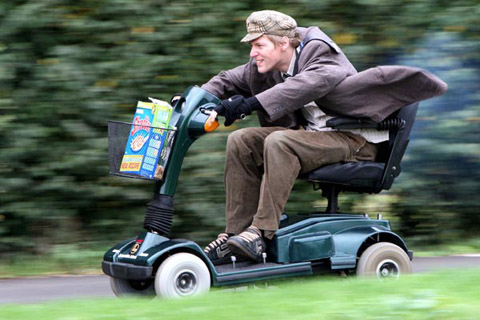
Although I don't have statistics in front of me, I know that many Canadians are turning to electric four wheel and two wheel vehicles to get around.  The four wheel vehicles (also called mobility scooters) are often used to go to supermarkets for shopping, and can in fact go right inside the mall or supermarket, because of their electric technology, and because their owners have great difficulty walking.  You may not want to call these things "cars", but they use the same technology, and they perform the function that a car used to perform, but do it better.  Their batteries and charging systems are adequate today,  to accomplish the goal of shopping.

A second use for an electric car, this time a more conventional electric car, is getting kids to school.  School busses do not carry all the kids, for proof you only need to go by a school at 3:00 to see all the parents waiting for the kids to come out.  Those people drive their kids to school or back four times a day, with a cold start each time.  And it is getting to the point where some families have a minivan that is only used for this one purpose.  Toyota is having some problems with engine failures in minivans whose oil turns to sludge and burns out the engine, because the vehicles never get operated for more than 15 minutes at a time. So the engine never has a chance to get up to operating temperature.  Families who use a minivan like this, usually also have huge four wheel drive pickups and SUV's that they use for longer trips, relegating the minivan exclusively to school shuttle duties. It would make a lot more sense for this type of work to be done with an electric vehicle, that needs no oil changes, no gas fillups, no warmup time, and does not burn out the engine on stop and go driving.  200 mile range and top speed of 100 mph are not needed in this application.  Just plug it in at home and drive around the block when you need to.

I don't necessarily agree with driving the kids to and from school four times a day, but I'm just observing the "real" world that I see developing around me.

Picture: Taken from this website "EV World The Future in Motion"

http://evworld.com/news.cfm?newsid=27678

Kamis, 10 Februari 2011

Toyotas Are Not Death Traps

By The Lost Motorcyclist, February 2011

Still seems weird to me, a guy who drives a motorcycle having to explain why my Toyota is not a death trap.

With the debate still raging about Toyota's "sudden unintended acceleration", it seems to me that everybody is losing the perspective.

The story that keeps emerging is that Toyota was sitting on its hands doing nothing about sudden unintended acceleration, while all the other carmakers had already built in a brake pedal override, to prevent runaway full throttle acceleration. This is a very narrow point of view.

There is a far more serious problem with front wheel drive cars than SUA. It is losing control in a curve, and possibly sliding sideways and rolling over. I'm not saying this happens to everyone, but it happens much more than sudden unintended acceleration. It kills more people, and it is more difficult for even a fairly good driver to control.

Knowing that skidding in a curve was killing so many people, Toyota had made their goal to put stability control on every Toyota model. The Electronic Stability Control is much more difficult and expensive to make than the "Brake Override". And it would save hundreds of times more lives. This is where Toyota was going, and still is going, despite the billions of dollars lost with the SUA witch hunt in America.

But still, with all the Toyota bashing going on, you might think that Toyota was doing nothing to improve car safety.

Brake overrides are a useless feature for anyone who knows how to turn off a car engine, or put it in neutral, or use the brakes properly. But an Electronic Stability Control would actually save hundreds of lives. While it is easy to learn how to turn off the engine in an emergency (hold the button to a count of three, and you have maybe a minute to remember this and do it) it is actually quite difficult to control the rear end spin out on a front wheel drive car. (Accelerate and turn the steering wheel against the skid, and you have .5 seconds reaction time to do this or you are too late).

The fact is that although it is very cheap to put in a brake override, unfortunately it involved adding lines of code to the acceleration system. Which in turn makes sudden unintended acceleration, or maybe some other fault, more likely. One way Toyota has made its cars reliable over the years by trying to stay a bit back from cutting edge technology. Reliability is not glamorous, but many older customers like it.

When Toyota does innovate, they try to make it worth while, like making the car safer in rollovers or skids. They were on the right track, and I hope all this hysteria does not deter them from being the standard that other car makers must live up to. Because we all benefited from that.

Audi found a way twenty years ago to mostly prevent drivers from using the wrong pedal. They put in a lockout that prevented the driver from selecting any gear unless their foot was on the brake. That put a stop to Audi SUA problems. According to Wikipedia, on Automatic Transmission,
"In many modern cars and trucks, the driver must have the foot brake applied before the transmission can be taken out of park."
Of course that is only a front line defence, and can be defeated by a determined person by putting their foot on the accelerator when the selector is in "Drive", and then forgetting that they moved their foot from the brake to the accelerator, and then the accident is waiting to happen. I don't know if all Toyota have this brake lockout feature, but with many times more cars than Audi, they will still have some problems with extremely forgetful drivers.

How to put a Toyota Highlander in "Drive" from eHow.com

http://www.ehow.com/how_7213720_put-toyota-highlander-drive.html
  1. Place the key in the ignition and turn to the "On" position. The Highlander does not need to be turned on, but the key does need to be turned to "On" to shift gears.
  2. Press the brake pedal and push the lock release button on the shift lever.
  3. Slide the shift lever until it lines up with the "D" for drive.
Picture: Our Matrix heading out of town with the snow cleared off the windshield first.

Rabu, 09 Februari 2011

The Toyota Verdict is In

By The Lost Motorcyclist February 2011

The Toyota electronic engine management system is not guilty for the sudden unintended acceleration. The tests were run for months by the US government, with NHTSA and NASA contributing.

Unfortunately, Toyota is not out of the woods yet. If indeed this was mass hysteria, several other things need to be cleared up. For example, most people seem to think that only Toyotas have experienced SUA (sudden unintended acceleration). If that were actually true, then this verdict is only the start of the investigation. However, it is not true, and if the hysteria is to stop, then that information needs to be publicised.

Also, when people become convinced of a false story, their first reaction when being confronted with evidence to the contrary is to dig in even more. That is why many first reactions are similar to "No surprise, the US government was paid off by Toyota". Those people are not going to be convinced by anything unless it proves Toyota guilty.

It is actually very difficult to prove that nothing can go wrong in a complicated computer system. But a far more complicated system, also involved in the crashes, that was not tested by the NHTSA, was the human brain. The NHTSA was very reluctant to call it driver error, preferring to use the term "pedal misapplication" for the majority of fault reports.

In the now famous case that touched off the hysteria, the throttle was stuck under the carpet, and a presumably competent driver (police officer no less) was unable to shut off the engine, or shift into neutral, or apply the brakes properly to bring the car to a safe stop. According to the US Government, the correction will be to have a brake override on all cars, so that applying the brake will reduce engine power. A second corrective action will be to make the engine easier (or more intuitive) to turn off in cars (ALL cars) with keyless ignition. Both of those, (currently not required by law) in my opinion amount to making cars more "idiot proof", no offence meant to anyone who is not present to defend themselves.

This Toyota SUA scare is a classical mass delusion. The basis for most human delusions is a brain fault (*or feature!) called "selective awareness". This is how it works. When too many things are going on that don't affect you directly, you tend to not notice them, they become part of the background noise. Then for whatever reason, if you should become aware of one particular type of thing, suddenly you will get overwhelmed by how many examples there are of that type of thing going on. Meanwhile you will remain completely unaware of the rest of the "background noise". Let me give you a simple example. You drive to work each day not noticing which types of cars are all around you on the highway. But then one day, you decide to buy a Toyota RAV4, you visit the showroom and look the vehicle over. The next day, I guarantee you will notice every RAV4 that you pass on the road, and you probably never realized how many there were.

The truth is that all carmakers suffer from the same, or quite similar, problems. Most of the time people turn a blind eye to car accidents causing death because this goes on all the time. People do not want to give up their cars so they ignore the accident statistics. In the USA, that amounts to about 40,000 people killed each year. There were 5 Toyota deaths supposedly due to SUA over several years. Then one famous accident gets everyone's attention and suddenly people open their eyes to accidents, but only Toyota accidents. All the other accidents are still going on in the background, but nobody is paying any attention to them.

Toyota got in a very difficult situation where everything they did made the hysteria worse. First of all, they did not report the floor mat jamming the gas pedal right away, and were eventually heavily fined for it. I still don't understand why they needed to report to the US government a "flaw" where a floor mat slides over a gas pedal and holds it down. I don't even consider that a vehicle flaw, to me that is more operator error. If that happened to me, I would not go to the dealer to have it corrected. (but I don't have the official Toyota heavy duty floor mats)

Then, Toyota made things worse:

- apologised for the deaths and took responsibility
- recalled millions of cars (to straighten the floor mats?!?!?)
- did not blame the drivers for being stupid
- did not present statistics proving they were not the only car models with SUA accidents
- did not put the blame on the American throttle pedal manufacturer.
- did not press charges against the driver who deliberately crashed his truck into a Toyota showroom and blamed SUA

This behaviour is typical Toyota corporate culture, unfortunately it did not serve them well with a hysterical American car market out looking for blood.

Picture: This is my car. Yes it is a Toyota, but I do not work for Toyota. I will brush all the snow off before driving away. But if I didn't know how to do that, I would not blame the car for not having a "Blocked Vision Override".  (One day we may have to have those.)

Selasa, 01 Februari 2011

Hating on the Hatch

Here is the Wikipedia entry. Interesting comment in there that hatches are only popular in Europe and a few parts of Asia! There was no citation available for this opinion, though.

http://en.wikipedia.org/wiki/Hatchbacks


The first hatchbacks were introduced in North America when I was in Africa in about 1969-1972. When I got back home, I had a lot of other changes to distract me from the fact that some cars now had a hatch instead of a fixed rear window.


The Honda Civic started out as a hatchback in the seventies. Now we can't get a Civic hatchback in North America, even though they are available in Europe. I am told the reason for this is that Americans hate hatchbacks. But I love them, and have never bought a sedan type car ever. I did a bit of research into the supposed hate for the hatches.


From comments on the Internet:

  • America is a big uncrowded country and hatchbacks are for crowded places like Japan and Europe.
  • Hatchbacks tell the world I'm too cheap to buy a car with a real trunk.
  • Americans don't like taking things in the rear. (Good one!)
  • It's a teenage car (heard that one in real life too, but not about me thankfully)
  • Ford Pintos were hatchbacks, and they used to blow up in a ball of fire when rear ended, so logically all hatchbacks do the same.


Enough of Internet comments. Now for some things left unsaid. There is the gay consideration, as there is with every issue from wearing hockey helmets to putting mustard on a hot dog. How gay are hatchbacks? Not particularly, if you check Gaywheels.com top ten list.

http://www.gaywheels.com/ten_most-researched_rides_at_g.htm


Now in my own opinion, the real reason why hatchbacks are out of favour compared to sedans in America is that if you need to dispose of a dead body of someone you just shot, a trunk is the ideal place. Same deal for pickup trucks. Why does no one mention this on the Internet?


Seriously, though, a practical consideration of storage space. The trunk on a sedan is better than a hatchback in case you ever get in an accident, because if you keep them in the trunk, your tool kits and axe collection will not be flying into the passenger cabin. But on the other hand, if you don't have to worry about an accident, you are more likely to be able to fit large objects into the back of a hatch than a sedan.


Another practical difference is that a hatchback's back window gets dirty on a wet road. Same for station wagons, SUVs, and minivans. Sedan back windows stay remarkably clean, and I have never seen one with a wiper/washer setup.


We are getting a few new hatchbacks this year like the 2011 Ford Fiesta and 2012 Focus. Soon the Fiat 500. And we have a fair number of decent hatchbacks to choose from. Other hatches include the Mini, the VW Golf, Mazda3, Mazda2, Audi A3, Kia (Forte and Rio), Toyota Matrix, Scion Xb, Nissan Cube, Volvo C30, Nissan Versa, Subaru Impreza, Honda Fit, and Smart Fortwo.


Picture: one of the first hatchbacks, a Citroen from http://en.wikipedia.org/wiki/Hatchbacks

Rabu, 26 Januari 2011

Forget About the Price of Tea in China. Think Buick.

I was surprised to find out that GM sells more vehicles in China than in the USA. So, imagining hordes of Silverado pickup trucks with gun racks and cowboy hats cruising downtown Shanghai, I went to look up some confirmation.


While it is true that GM sells more vehicles in China than the USA, there are several related facts that make it less surprising. First is that these vehicles may not be "made in the USA", and their brand names may not be recognized by American customers. There is an active partnership between GM and several Chinese companies.


But there is also the story of Buick. The typical Buick owner in America is basically an old fart who can't afford a Cadillac, in China the Buick nameplate is revered. This may be due to the last Chinese Emperor, Pu Yi, having owned a 1932 Buick Tudor.


Picture: Hopefully the Emperor had the good taste to not pimp out his ride as much as this. From this web site http://www.verztec.com/blog/?p=346


From the Wikipedia entry for Pu Yi. I have to confess, it is way too complicated for me to figure out from this, exactly why this guy should set the standard for the Chinese car buying public. In the article I did notice that he was the one who kicked the Eunuchs out of the Imperial Palace. Don't know if that was bad or good. Then he was the emperor reputedly collaborating with the Japanese invasion before WW2, and was captured by the communists and spent time in jail. And somewhere in there, he had a Buick. Then, apparently by some mysterious butterfly effect, GM ends up selling more cars in China than in the USA. Well, I don't get it.


So, GM is selling a lot of Buick branded cars in China. In many cases these cars are rebadged Opels from Germany or Holdens from Australia.


Nice to know that even in China, the marketing of the automobile is based on the sizzle and not the steak.


While I may have been surprised, the "China Car Times" was not, with the headline "No Shocking news: GM sells more cars in China than it does in the USA"


In the China Car Times, the writer is pleading for someone to enlighten them as to why Buicks are not revered in the USA as much as in China. I have no answer for them. Other than the obvious, of course.

Rabu, 19 Januari 2011

Is the Jeremy Clarkson Ford Fiesta Test Fake?

Jeremy Clarkson Top Gear road test of the Ford Fiesta Youtube video

What a piece of marketing propaganda, and coming from where? the most unlikely source, the BBC!

A Ford Fiesta gets tested by a TV car show called "Top Gear". In the test, it is allowed to take part in a beach assault. It is carried by a Royal Marines landing craft and Jeremy drives it ashore under fire to let off one of the soldiers on the beach.

The episode has got to have had a huge positive impact for Ford Fiesta sales. Ford could never have hired the Royal Marines for their own commercial, and even if they could, it would not have had the same powerful effect. But apparently the Royal Marines are willing to cooperate with a BBC TV show, and in return they get some positive media attention for themselves.

During this spot, Jeremy manages to avoid looking like a Fiesta commercial by calling the car shit several times (but only the stripped down model) and dismissing its "green" features in a joking way. However, everything else he says about the car feeds a fantasy image that Ford could only hope for in its wildest dreams.

Although Top Gear apparently started out doing serious car testing, they have gradually gotten into more faked and thus more exciting simulations. I guess they found that this was the way to increasing the number of viewers.

One viewer apparently missed the old style road tests, and wrote in asking to go back to real car testing, which inspired Jeremy to do this totally over the top "serious" mock road test of the Fiesta.

So instead of seriously considering the power, fuel efficiency, space, reliability, speed etc. in comparison to another car, Jeremy sets up a series of exaggerated so-called tests that are faked to show off the best aspects of the Fiesta. Luggage space? A stuffed Zebra head happens to fit exactly in the back, and so that is judged excellent. The Fiesta is small and maneuverable, so he stages a chase in a Mall against a much larger and more powerful Corvette. I believe it is possible that the Fiesta would win, given the slippery floors and extremely limited space. But the whole fake chase was scripted and choreographed like a Hollywood movie. And he should have put the Fiesta up against a Honda Fit or a Toyota Yaris. And finally, nobody drives in a mall anyway. Of course we all knew that, didn't we? especially the last one.

But Jeremy was not finished yet, the Royal Marines beach landing was next. The Fiesta went off the landing craft and was immediately over the "bonnet" in salt water, nose down. That apparently didn't kill the unsnorkeled engine. Also, the front wheels with regular street tires on them had no problem finding traction on the mud or sand under the water, and the Fiesta plowed its way, apparently with no help, up onto the beach. I have driven on beaches at times, and I would not try that. The beach above the water line seemed hard packed enough to drive on, so that part was credible, but not the part under the water. In fact, if the Fiesta could drive through the water, we would have a whole new class of amphibious assault vehicles being tested right now.

The real outcome of the test was probably at least one written-off green Fiesta. And if they did, I'm sure Ford would be happy to write it off. We are not told if they have paid any other money to make this show, but really I would not be surprised.

Picture from this blog, that mentions the Marines came up with the idea, and specifically mentions they understood the show as comedy, not a serious test. It does not mention that any spectators were allowed to watch. I figure either a tow rope, or an underwater ramp would do the job, but I was not able to find any confirmation.
http://www.fquick.com/blog/Jeremy_Clarkson_drives_Ford_Fiesta_into_Sea/2506

Selasa, 18 Januari 2011

2011 Ford Fiesta Hatch for Fuel Economy Fans?


I happened to be at a Ford dealership yesterday and noticed a 2011 Ford Fiesta hatchback. What caught my eye was the Transport Canada rating of 58 mpg highway, significantly higher than my Toyota Matrix's rating of 48 by the same agency. (Canadian gallons, or 4.9 l/100km)) Because I like the hatchbacks, and cars with good fuel economy, I stopped in to talk to a salesman and find out a bit more.


There were some very interesting discoveries. First is that the high fuel economy comes at a price. Usually, you can get the best fuel economy on a stripped down standard transmission model with no options. Now economy is being marketed as an option. The Fiesta has a "Super Fuel Economy" package listed at $500, which is "side tire deflectors, underbody shields, lower grille blocker, cruise control, spare wheel with wheel cap (?), and a rear spoiler on the sedan. (the hatchback has a spoiler standard). Then the book says "requires 6-speed automatic." The six speed auto is listed at $1250 and it is a dual clutch transmission, automatically shifted for you.  My Ford booklet did not mention the low rolling resistance tires, that I think are also part of this package.

The SFE package is worth 3 mpg, the automatic transmission has a 2 mpg advantage over the manual, so it will cost to make those extra drops of gas work for you. And the six speed has no manual shift mode.

According to the MPG-Omatic test below this Fiesta is missing an real time mpg readout (I cannot confirm this yet , apparently it is standard on the Euro model) , which I will want for my next car. That is a pretty cheap item to add, and I want one. I think they should be in all cars, even Hummers (as a punishment). But in a Fiesta with good fuel economy, it would be a shame to miss it.

The Fiesta hatchback is 3 in. lower and 11 in. shorter than my Matrix. The hatchback model is simply the Fiesta sedan with the trunk lopped off. So it has less overall room than the sedan. I would prefer a station wagon type, where the roof line is extended to the end of the sedan's trunk, to get more room. Or at least part way. The hatchback is not available in standard trim, and so it is also more expensive than the sedan. That was a problem I had with the Mazda 3 hatchback five years ago, where it was not available with the standard engine.

Speaking of engine, I like variable valve timing, which is becoming more common. This Fiesta has a 1600cc "Twin independent variable camshaft timing". Unless this is just marketing hype, I'm assuming that is better than my Matrix's system of adjusting both camshafts together.

Anti-nibble electric power steering which compensates for wheel imbalance, side winds and road camber. If I was to take a test drive, that's something I would be paying close attention to. Being as lazy as I am, I hate constantly having to move the wheel back and forth, and correct for side winds. One more step to the car virtually driving itself. And of course I hate the feel of a vibrating steering wheel.

Another fuel economy booster is the tire pressure monitoring system, which is standard. But it's kind of expensive to then add winter rims and tires, because I believe the new rims will need new sensor units in each one. Maybe I would just forget about the tire pressure monitoring on the winter rims.

So to sum up, I thought the hatchback with good fuel economy would be available as a base model, but I was wrong. The hatch is an upscale model only, and I would also need the automatic transmission to get the best fuel economy. I'm going to need a new car in about ten years, so that gives some car maker the chance to look at the Fiesta, and make a hatchback model a bit longer, in standard trim, with an MPG readout on the dash (that I do not have on my Toyota Matrix). I don't mind shelling out $1500 for a 6 speed dual clutch automatic, if it gets better gas mileage, but make sure there is a manual override. That would make it more fun.

I forgot to mention the Fiesta fuel filler with no screw on cap. Last night I almost could not get the Matrix cap back on, I was shivering from standing there in -10c waiting for the gas to fill up. (yes I was wearing a parka and gloves) I want one of those no-cap fillers.


http://www.mpgomatic.com/2010/09/19/2011-ford-fiesta-review/

Selasa, 04 Januari 2011

Minivans May Never Become Cool

Back in 1984 I bought a minivan the first year they came out. It was a Plymouth Voyager, and it had a 2.2 litre engine. I ordered it with a manual transmission for fuel economy, and extra performance, but it was still not really fast or particularly fuel efficient. Its best features had to do with kids, and I had three of them. No door on the street side, so no danger of kids jumping out the wrong side. The sliding door also meant no danger of dinging the car beside us when they piled out of the van in a mall parking lot. And all three had their own window seats, with little opportunity for poking each other during the drive. Finally, it fit in my garage, and in our fairly short driveway. Chrysler called them "Magic Wagons" and they were indeed magic.


I was aware from the start that the minivan did not cut a dashing image out there on the streets. This was never going to be a classic car. James Bond agent 007 was never going to be seen outrunning Russian spies in a minivan, or even seducing the ladies after driving them at scary speeds on mountain roads in the French Riviera. But it was not important enough to give up the practical advantages for the fantasy. However, owning the minivan may have helped later to push me into the decision to buy a motorcycle with six cylinders, as a way of overcompensating.


This morning, I saw a CBC report on minivans in the morning news. "Will Minivans Ever Be Cool Again?" My first thought actually was that the CBC was cutting corners by running a canned piece from a Toyota ad agency. I noticed it was mainly about a new Toyota Sienna ad featuring a Mom and Dad and two kids, with the Mom and Dad doing a rap music video, and saying they called their minivan a "Swagger Wagon". Further mention was made in the video that another maker was calling their minivan a "people mover" and another was calling it a "Man Van".


No matter what they call the minivan, they are going to have a hard time shaking loose the image. These are vehicles that parents buy to drive their kids around in. Even if a young person (say up to 25) bought one of these, everyone who saw them would immediately assume that they were driving Mom's car because they still lived at home and went to school, and they didn't have a car of their own.


I thought it was also significant in the video that the family had two kids. Many years ago, 8 would have been the norm, then it gradually dropped. Two kids is a respectable number these days, and I expect one day the norm may even go down to one. Minivans make most sense for bigger families, (3 kids or more) while apparently families are getting smaller.


I think the cool car today is the SUV. Instead of your vehicle saying "I'm driving Mom's car because I live at home" it says "I live on a mountain top in the Rockies where I shoot moose and grizzly bears, and this is the only way I can get home."


The facts, of course are totally different from the image. Although granted, occasionally I see somebody driving an SUV who actually might fit the image. For example, one person I met had an SUV because he had to drive up a luge track to get to his house. Most people have paved driveways.


I don't know if this ad campaign is aimed at me, but if it is, it is a failure. I have seen many ad campaigns that turned me off over the years, and this campaign also has the effect of making me want to never buy another minivan. "Man Van" and "Swagger Wagon" are horribly embarrassing. Rap music is something I have never had the slightest feeling for except disgust that it ruins real music for everyone.


Here are two examples of Mercedes car ads. The third one is the Toyota ad.

Banned Mercedes ad "Not in this weather" http://www.youtube.com/watch?v=mi47UcyK4Ms

Crazy for a different reason, but at least its work safe http://www.youtube.com/watch?v=joC5MvzO1_w

The Swagger Wagon commercial http://www.youtube.com/watch?v=ql-N3F1FhW4


I have not had a minivan since I got rid of the Voyager back in 1996, I bought a Honda Civic with good gas mileage and sporty performance. That was after the kids had basically moved out, or at least I didn't have to transport the gang around with me. After the Honda Civic I bought a Toyota Matrix because the higher door and seating position makes it easier for my increasingly creaky bones to extract themselves from the car.


The last time vans were cool with kids was the seventies, when they were "Shaggin Wagons". If you drove one back then, everybody still assumed you lived at home, but at least you had your own vehicle, and a girlfriend or a shag rug.


Minivan sales are down from over a million in 2000, to under half a million today. The marketing people are going to have to try harder to come up with a winning concept. Let me throw this one out for them, since they are having such a hard time. Promote the idea that driving a minivan makes you lose weight. According to a recent health survey, Canadians apparently think driving the kids to a hockey game is a healthy activity. I know it's not true, but in marketing, you have to go with the flow. Work with the subliminal messages. For example show fat people walking to work and playing hockey, intercut with fit thin people driving minivans. Now there's a winning idea in sales campaign. Remember you sell the sizzle, not the steak.


Picture: I am surprised to see a 1984 Plymouth Voyager in a museum. Mine was the basic model with no wood grain panelling, without even a right side mirror. (each outside mirror was $70 extra) In those days the 401 had only two lanes, who needed a third mirror? But I did need a third row bench seat, and that was $800 extra. http://www.flickr.com/photos/harry_nl/3039372888/

Sabtu, 18 Desember 2010

Low Tech Winter Driving

What I call low tech is winter driving without a cell phone, without anti-lock braking, without anti-skid computer systems, no cruise control, no automatic transmission, no GPS, or Blackberry, and no all-wheel drive. To some people this is madness. Especially when I tell them about driving to Labrador in February. But it was not that surprising, as the road to Labrador has no cell phone towers anyway.


But despite my lack of cutting edge technology in certain areas, I will make use of some other new developments in the world of winter driving. I will use the Internet or the weather channel on TV for radar images of weather, and for road and weather reports before setting out on a trip. I do have winter tires, and beam type windshield wipers, two new products for winter driving that have gained a lot of popularity in the last ten years or so. I currently have synthetic oil in the engine, which works well at low and high temperatures. My car is fuel injected, meaning it generally starts quickly in cold weather, and with no choke twisting. If you still call front wheel drive high tech, I have that too.


My first car was a 1956 model, which did not have a windshield washer system. While the washers are a benefit in the summer, they are essential equipment for winter driving. And just as some technology advances are now taken for granted, some regression has occurred too. Remember when cars all had a full sized spare? In another trend, recently, car tires have gotten a lot wider. Although this may have some benefits on dry roads, when dealing with snow and slush the old style narrow tires work better.


If you read the weather maps correctly, you will not be out of the house in bad weather, and so you may not need the following advice. But it happens, so...


If you are out in the snow already, you should observe the road and weather conditions outside your car windows. I have a thermometer on the car's instrument panel that gives me the temperature outside. At 0 or -2 degrees C on damp evenings after the sun goes down, beware of bridges. They often form black ice first. And slow down when visibility is obscured, or when the road condition is snow or ice covered. If I can, I get off the freeway when I think conditions may deteriorate quickly, because that is when the deadly 50-car pile ups generally occur. But I only do that when I know the local roads fairly well.


The worst problem in the winter is crashing due to loss of control in icy or low traction conditions. Here, ABS can help, and so can anti-skid systems. But better than either of those, would be equipping a car with winter tires. Although ABS and anti-skid may keep you from spinning, they do not help you stop faster, or help you stay in your lane in a curve, the way winter tires can. If you drive a low-tech car without ABS, you should at least learn to pump the brakes, which helps you maintain control while still slowing down as best you can.


Don't forget that sometimes, it's not you hitting something else, it's another car hitting you. You have very little control over that once you make the decision to sally forth into the winter wonderland.


A front wheel drive car without an anti-skid system is vulnerable to spinning around (also known as losing the back end) in slippery corners. You need to learn to point the front wheels to counteract the spin, and if you have front wheel drive, to accelerate instead of backing off the throttle. Another option instead of accelerating would be to press the clutch pedal. You will only make it worse with a front wheel drive car, when you take your foot off the gas. This will have the effect of slowing down the front end of the car while the back end continues past you at speed, starting a skid where you can end up backwards on the road, or in the ditch, or worse.


The second worst situation in the winter, after crashing, is being stuck far from help. It's to prevent this possibility that lot of people buy four wheel drive vehicles. I think that some people put a bit too much faith in their four wheel drive technology, with the result being, that they are still as likely to get stuck, only much farther from any help. Instead of four wheel drive, I put my faith in a snow shovel in the back of the car. But I know how limited that is, even with Mary Ann out there pushing the car after she clears all the snow from in front of and behind the tires.


One way to get stuck is not just because you can't move yourself, but because the traffic around you is all stuck. In cases like that even snowplows can't move. Another way to get stuck is to pull off to the side of the road and accidentally drop into the ditch, which is hidden because the plow pushed the snowbank back too far. Of course other situations should be preventable, like running out of gas. Always try to keep the tank more than half full in winter. And it would be a good idea to have a working gas gauge.


With an old, unreliable car, there are hundreds of ways to get stranded. (e.g. run out of gas when the gas gauge does not work) I'm sure all are amusing and I have many stories myself which I will not bore you with here. At this time, I am driving a 2005 Toyota Matrix, which has so far been utterly reliable, and that is mostly why I bought it. Reliability is a feature that does nothing for the sexiness of a car, but it has a lot of appeal in winter driving. If you have ever been forced to step out of a warm car in a blizzard you will know what I mean. I don't mind paying extra for a car that I know will just keep working no matter how cold it gets out there.


When driving in Canada in January, never fool yourself into thinking you can dress for the summer, just because you are in a car. Dress for the winter if it's winter. Turn down the heater in the car a bit, or remove your toque and gloves in the car to stay comfortable. But make sure you have the boots and whatever other clothing you need to get outside and keep on living.


Every winter there are new drivers out there, who for whatever reason have never driven in snow before, and think they have a "better way". Especially when it comes to eliminating such burdensome tasks as brushing the snow off the car before starting out. I spotted one such genius, who was driving through a mall parking lot, with a huge pile of snow on his car, and all the windows obscured as he had decided let the snow fly off in the air all by itself while driving. As he drove through the lot toward the busy road, lots of snow was flying off the car, leaving a dust cloud and whiteout conditions behind him. The driver decided that he needed go faster, as the snow was not coming off fast enough and he still could not see where he was going. So he accelerated toward the intersection, with even greater clouds of snow coming off, and the deep pile of snow on the hood and roof gradually wearing down. The plan was working, in a way, but still no luck seeing out the windows. At quite a high speed, the car crossed the raised sidewalk, flew past the stop sign, and came down hard in the middle of the busy the street. I don't have to imagine what this display looked like to the oncoming car drivers, as I was the driver that came closest to hitting the snow comet. As it went over the bump,the remaining snow exploded off the car into the air, and the driver could finally see where he was. Nobody hit him, and that's an indication of how many Canadians drive defensively in winter. And why.


Picture: Our Toyota Matrix outside the Lion's Head Beach Motel on a winter trip in 2008. Here's my 30 second "How to drive in snow" video, of Mary Ann driving out after a plow went by and blocked the car in.

http://www.youtube.com/watch?v=gOOmiywKN7U

Sabtu, 30 Oktober 2010

Power Steering: Technology Marches Forward

Having discovered that the newest Toyota Matrix has electric power steering, I decided to do some research into it.  Back in February, apparently some people were trying to sue Toyota for defective electric power steering units causing fatal accidents.

I am going to assume it was just another mass hysteria, (although based on a reasonable question) similar to the "Unintended acceleration", except that apparently "sudden unintended steering" never really caught on with the US media. The main difference is that there is a real mechanical connection between the steering wheel and the front wheels. There was no similar connection between the accelerator pedal and the fuel system. That, and a lack of heart wrenching but gripping stories to drive the general panic.

So now I am just going to make some remarks about "Power Steering" and technological refinements of cars.

My first car was a 1956 Chevy, and one of the many clues to its age is the big 18" diameter steering wheel. Modern cars all have 15" steering wheels. Since the change in size approximately follows the introduction of power steering, there may be some connection. Maybe the big wheel helped make the steering easier? I'm not sure, because there was already a gear reduction in the steering system.

Steering feel is very important to the driver of a car, and the car makers work hard making it feel "right". The steering wheel is supposed to provide feedback to the driver about what the wheels are doing, but it should not provide too much feedback. The steering wheel should give some resistance to being turned, but not too much. The steering wheel has to feel right making a U turn in a parking lot, and the same steering system must make you feel confident at 150 kph, whether in a straight line or in a curve.

All power steering systems are "power assist". It is not safe to eliminate the mechanical connection between the steering wheel and the front tires, in case of failure of the power system. The first power steering systems were assisted hydraulically. The latest systems are using electric motors to assist in turning the wheels.

There is only one time that I have felt the effect of a power steering system cut out. I was driving a 1966 Dodge Coronet around a traffic circle when the motor stalled, and the power steering went dead. It's amazing how fast a car can get away from you in a situation like that, as the steering effort goes from very easy to needing both hands and most of your strength. While this was happening, I think I figured out that the power steering had stopped, and what was most scary was gradually applying more and more force to the steering wheel with nothing happening. I'm sure it was no more than 2 seconds before I finally pushed hard enough to move the steering wheel, but it felt like a long time, and I was not sure that it ever was going to turn.

Now I have a 2005 Toyota Matrix with variable assist Power Steering, using the old fashioned power steering pump. My previous 1992 Honda Civic had no power steering, and it did not need any. When I first bought the Matrix, I didn't know about the variable assist power steering, and during my test drive, the steering felt normal. Power steering systems are quite unobtrusive, but they do change the "feel" of the steering system.

For the first 8 months that I owned the Matrix, I began to gradually notice something unusual about the steering feel. But because it was the first car I had with low profile tires, I did not know whether the strangeness was due to the tires or the car's steering setup. On the freeway, the car did not seem to track straight, it felt like it was darting from one side to the other, and it took quite a bit of force to get it back on centre. Of course, this feel was subtle, and you would only notice it with thousands of kilometers of driving. And I suppose, there was also the inevitable comparison to my departed Honda Civic's light, sports car-ish steering.

It was only when I installed higher profile and narrower snow tires on the Matrix that I noticed the steering feel improve dramatically. So I concluded that the weirdness was with the low profile tires. The original size was 205/55R16, and the winter tires were 195/65R15. So the winter tires were narrower and with a higher sidewall. When the original all season (summer) tires wore out, I considered replacing them with the same size as the winter tires, but I eventually went with the original size, to get the same speed and load rating. Not only that, but there were reports that the original Goodyear RSA tires were crap anyway, and a good tire would have better steering feel. So I bought a set of Michelin Primacy MXV4 tires, which actually felt even better than the winter tires. At this point I started to think the problem was the type of tire, rather than the profile and width. With a bit more investigation, it seems that the Goodyear RSA tires are "performance tires" meaning that they have stiff sidewalls, and make the car ride rough, and also tend to be a little bit unstable in a straight line. So actually, it was a combination of the variable assist steering "feel" and the high performance tires that came with the car. Apparently, the boost and feedback can be finely tuned on a new electric steering system. Some cars with EPS can change steering feel with the push of a button.

Maybe one day we will have power steering in motorcycles. Some snowmobiles are already there.

These days, new technologies sneak up on you. Back in the good old days, if a car maker introduced new technology, they would boast about it in full colour ads and it would be a feature that supposedly made all previous cars obsolete. Not any more. Many new car features either make the car safer or make them more reliable or cheaper to manufacture. And every time a new technology is put into production, some people will find a way to turn that into an accident where they can sue the car maker for millions of dollars. So the less we know about the technology, the better, as far as car makers are concerned.

This story of hidden technology reminds me of a GM car years ago that introduced a temperature gauge for radiator coolant. The needle of the gauge was proportional to temperature of the coolant, and provided some good feedback for the driver. It was a lot better feedback than the "idiot light" it replaced. (an idiot light comes on when the coolant is too hot, otherwise is off). Unfortunately, people can get obsessed with "too much information", and some drivers got worried sick about how slowly the needle rose to normal, (or how quickly), or exactly where the needle pointed at all times. Not only that, but they would compare their observations with owners of identical cars and note that their needle did not point to the exact same spot on the dial as the other car. Which to them was proof that their car needed a whole new engine. There was simply no reasoning with the obsessive owners. Finally the GM dealers got fed up and GM reverted to a gauge that was uncoupled from the coolant temperature. Unless the coolant boiled over, the new gauge was designed to rise from "cold" to "normal" in a uniform amount of time. Then it would remain pointing at Normal. If the coolant boiled over, it would point to "Hot". Pretty much an idiot light disguised as an instrument. The complaints stopped. Obviously, some car drivers could not handle the truth.

Sad to say, but advances in human intelligence have not been keeping pace with advances in technology.

Picture: '56 Chevy's 18" steering wheel. But did it actually help turn the wheels before power steering was common?

Minggu, 29 Agustus 2010

Baby Killer Toyotas?

I wish I had bookmarked this comment, but I didn't and I can't find it. However, I have decided it is an important enough issue, just on principle, for another Public Service Announcement"

The comment was made in response to the Toyota Sudden Unintended Acceleration problem. The issue is turning off the engine, where on a keyless ignition, at highway speed, you need to hold down the button for three seconds before the engine shuts off.

One commenter had something like this to say. My baby is sleeping in a room right in front of where I park my Toyota, and is protected only by a flimsy wall. The truck could easily reach and kill the baby before I can say "one-Mississippi two-Mississippi three-Mississippi" and shut the engine off.

This particular comment does not appear so extraordinary at first, but it popped back into my head later. Did this person convert his garage into a nursery for the baby? That would explain the flimsy structure, as the garage door might be flimsily boarded over to look like a wall. Anyway, lets look at all the problems with this scenario.

You should not put your babies in front of vehicles unless you have a reasonable barrier to protect the baby. This would go for all human beings, by the way. The most common way for an accident to happen here, is the driver gets in the car or truck, starts the engine, accidentally puts it in drive, instead of reverse, while forgetting to hold the brake. The truck lurches forward, and the driver is too shocked to respond, or worse yet, responds by mashing the accelerator in haste instead of the brake, compounding the problem. This is not a Toyota problem at all, and it is not entirely a stupid driver problem. It is a situational problem. You should not set up a situation where the vehicle could easily kill somebody if you make a simple mistake. Mistakes happen, so try to avoid setting up traps like this.

Now about the three second delay. This delay is only when the car is at highway speeds. When stopped or parked, the shutoff is instantaneous, just the way it works every other time the driver turns off the engine.

If you hold your foot on the brake, the car or truck will not move, even if you give it full gas. I have tried this with a sixties-era car, and brakes were not as good then, but the engines were pretty powerful before anyone started worrying about fuel shortages. And when the car is not actually moving, the brakes will hold the car as long as you can press your foot down, they will never burn up. On the highway, it is possible to burn out the brakes if you don't stop the car.

Another thought, is the truck parked uphill from the baby's flimsy chamber? Because in that case you may cause a lot of damage just by forgetting to put it in park or not applying the parking brake.

There are certainly two aspects to this story. I have had kids myself, and I know how hard it is to prevent them from getting run over by a car. They manage to escape in an instant, and head right for the nearest busy road to cross. It has happened to me. Drivers often speed through our quiet dead end street neighbourhood, until speed bumps were installed, and then they started taking short cuts over the lawns to avoid the speed bumps until a neighbour placed a rock ornament in the middle of the lawn. Now its a lot safer for kids. That's what it takes to protect kids. You baby would be taken away by a child protective service if you ever put your baby to sleep in a cardboard box in front of the wheels of a parked vehicle. The reason you do not have your baby taken away is only because your structure is stronger than a cardboard box. But how much stronger?

It's too bad that emotional situations like get dragged out just to add fuel to the Toyota hysteria. Many people get crazy when they just think of babies being hurt.

Selasa, 03 Agustus 2010

What is a Bland Vehicle?

Again, to correct a mistaken first impression, this car is an old Fiat 500, and I do not consider it bland. Now for the rest of the post.

Many months ago (it seems like years!), the Toyota acceleration problems reminded us of this topic: That the fun had gone out of driving. The segue goes like this. Toyota admittedly seems to build bland cars that your grandmother would want. Because Toyotas are bland, they are no fun, and drivers get disconnected from the act of driving to the point where they don't know what to do in an emergency. What's more, as it was later shown, most of the time the Toyota drivers cause the emergency, what with pushing on the accelerator instead of the brake, and not understanding how to turn off the engine or shift into neutral.

So now to deal with this topic, what exactly is a bland car or motorcycle? Once again, I fear that most people have misunderstood, and until it is properly thought through we will get nowhere with this.

A lot of people confuse "fun car" with high horsepower. Same in motorcycling, of course. Where actually, a fun car is much broader than merely horsepower. In fact, higher horsepower in many cases can work against the fun of driving.

I will admit that there is some fun in having a lot of horsepower. There is certainly a thrill in giving a powerful machine full throttle, and feel it pick up speed quickly. In a car, your back is pressed into the seat, and you feel your head tipping back. It may be accompanied by squealing rubber or black marks on the road. With a motorcycle, you may "pop a wheelie", and stretch your arms trying to hang on to the handlebars. And the satisfaction of leaving all the other traffic behind at the light as it turns green, having the road to yourself for a few seconds. Or passing a slow car in the blink of an eye.

But extra power is also something that dulls the driving experience. Many drivers feel they need the extra power because they don't like to shift gears, or so that they can accelerate without the engine making any loud scary noises. That's right, Grandma, engines make a lot of noise at full throttle at 10,000 rpm. In my opinion an awful lot of drivers want big powerful engines so that they don't have to think about how and why the engine makes power, or how to maximize that power. In many ways, a modestly powered engine is more fun precisely because of the power limitation. It forces you to think, not just about what gear to be in, but also when to begin accelerating for that big hill, when to give it full throttle before attempting a passing move. To drive a low power engine, you need to learn about powerbands, the sound of the engine, and transmission ratios. And possibly also about maintenance, like changing the oil once in a while before the engine blows up.

One thing is for sure, that the real fun of a high powered engine comes at full throttle. Yet the more powerful the engine, the fewer opportunities you have to use it to the max. And the less you learn about driving it.

What other things can make a car or motorcycle fun to drive? I would say steering precision, suspension compliance, cornering ability are all part of it. Also, the feel of the gearshift if it is a manual transmission. Of course, I'm talking strictly about street cars here, not off-road vehicles like 4 wheel drive jeeps, where the fun may also be in getting through a muddy puddle without burying the vehicle up to its' window sills.

I still believe motorcycles are more fun to drive than cars. They do not give that sense of invincibility that cars do, but that may be a good thing in the long run. But with a motorcyclist being out in the open, they are definitely more connected with the sound of the engine, the bumps on the road, the wind, rain, or or cold that they may encounter. And they are far more concerned about slipping on a patch of gravel, or balancing the vehicle at a stop. None of those sensations are helped much by a way-too-powerful engine.

Picture: A Fiat 500, which may not have quite enough power for north American highways (or even Italian for that matter). But although a few more ponies may be welcome (true of all cars by the way), still lots of fun to drive.

Jumat, 16 Juli 2010

Oil Spill Done, Hysteria Shifts Back to Toyota

By The Lost Motorcyclist

Now that the oil spill is over, time to focus the hysteria back where it really belongs: Toyota.

July 13, the "Wall Street Journal" put out a story titled "Early Tests Pin Toyota Accidents on Drivers"

The link to the article is here.

Here is a partial quote:

"One case studied by U.S. regulators involves Myrna Marseille of Kohler, Wis., who reported in March that her 2009 Toyota Camry accelerated out of control and crashed into a building.

Ms. Marseille said in an interview Tuesday that she was entering a parking space near a library when she heard the engine roar. "I looked down and my foot was still on the brake, so I did not have my foot on the gas pedal," she said.

Police in Sheboygan Falls, Wis., investigated and believe driver error was to blame, Chief Steven Riffel said Tuesday. He said surveillance video showed that the brake lights didn't illuminate until after the crash. But Mr. Riffel said that determination is preliminary and that his agency has turned over the investigation to NHTSA.

Based on the black box data, NHTSA investigators found that the brake was not engaged and the throttle was wide open, according to a person familiar with the matter.

Ms. Marseille sticks by her story. "It makes me very angry when someone tells me, 'She probably hit the gas pedal instead,' because I think it's a sexist comment, an ageist comment," she said."

Apparently, in the thousands of different cases to sift through, it takes a while to get the truth, if it's even possible. In the case of Myrna Marseille, although she swore she was pressing the brake, a video surveillance camera showed that she was not, the car's brake light came on after the crash. The car's internal data recorder is consistent with the surveillance camera.

This story in the WSJ got plenty of reaction. For example, Autoguide's title is "Report: Toyota ‘Planted’ Driver Error Story Claims NHTSA Insider"

You can read the original story yourself, (I hope) and see that Toyota and the NHTSA sources are actually credited right in the Wall Street Journal story, so "planted" is a misuse of the word in this context.

for example:

"A NHTSA spokeswoman declined to comment on the findings, which haven't been released by the agency."

"Daniel Smith, NHTSA's associate administrator for enforcement, told a panel of the National Academy of Sciences last month that the agency's sudden-acceleration probe had yet to find any car defects beyond those identified by the company: pedals entrapped by floor mats, and accelerator pedals that are slow to return to idle.

"In spite of our investigations, we have not actually been able yet to find a defect" in electronic throttle-control systems, Mr. Smith told the scientific panel, which is looking into potential causes of sudden acceleration.

"We're bound and determined that if it exists, we're going to find it," he added. "But as yet, we haven't found it."

"Some Toyota officials say they are informally aware of the NHTSA data-recorder results. Toyota officials haven't been briefed on the findings, but they corroborate its own tests, said Mike Michels, the chief spokesman for Toyota Motor Sales."

Toyota's biggest mistake was its early decision to not lay the blame on driver error. It's like sticking a bleeding hand into the Amazon river to check for Piranhas. I think Toyota is quite aware now that there are more bad drivers out there than they originally thought. Not just bad drivers, but people who don't have access to unbiased information in the news. And I haven't even got to the pathological liars yet.

Picture: Graph shows the complaints spiked after the news stories got out, and not when Toyota installed fly by wire throttles, as the Class action lawsuit lawyers alleged.

Senin, 29 Maret 2010

Another Toyota Throttle Scandal: This Time It Won't Open

I just happened to catch the finish of the Martinsville NASCAR race on TV this afternoon. It was won by Toyota 1-2 in a surprise finish.

Just to catch up on the shenanigans in NASCAR, Toyota decided to compete in NASCAR in 2007, and stirred up a hornets nest of fans and competitors who thought that NASCAR should be for American makers only. Very soon after Toyota's debut, NASCAR officals got an anonymous tip that Toyota was using a banned substance in their fuel. They tested the Toyotas and found the substance, then imposed stiff penalties on the Toyota teams. Some people lost their jobs over this fiasco. Nobody really knows who did it or why.

By 2008, Toyota cars make too much horsepower for Ford and Chevy to compete, so NASCAR has a rule that says if you make too much horsepower, measured on their dyno, they will mandate a restrictor plate for your cars to reduce the power to the same as the competition. Toyota continued to win, and the competitors called for another dyno measurement. Obviously those Toyota cars needed more restricting. But during the dyno test, it was discovered that somebody had installed a small magnet to block the throttle from opening fully for the NASCAR inspectors. This of course resulted in further sanctions, and an even more restrictive throttle plate for Toyota.

Those were the conditions today as Toyota won 1-2 with the double restrictive plates. It was kind of a neat finish, where two competitors were trying to block the faster Toyota on the last lap, running side by side. The Toyota driver rammed one of them from behind, then moved behind the other car as it accelerated to keep up. Then the two cars in front hit each other, went off to the side, and the two Toyotas got through for the win.

Best NASCAR action I've seen in 45 years. And the drivers can even blame a stuck throttle for the bump.

http://en.wikipedia.org/wiki/Joe_Gibbs_Racing

Disclaimer: I have not followed NASCAR for 45 years. I do not understand the rationale behind restrictor plates, nor do I understand the big picture of who is racing what class and why. If I have made any misstatements, and you can clear me up on this, please leave a comment. I have never heard of restrictor plates being used in automobile competitions before, unless it was for beginner classes or training purposes.